Come here… no, actually fuck off… but please don’t leave.

How Early Bonds Shape Safety, Connection, and the Stories We Carry
16 min read
// The Foundation: What Attachment Really Means

Attachment theory began with John Bowlby and Mary Ainsworth, who recognised that a child's bond with their caregiver is not simply emotional — it is a biological survival system. Bowlby argued that these early experiences create what he called an Internal Working Model — a mental blueprint that shapes our lifelong expectations of ourselves, of others, and of whether the world is fundamentally safe.

At its core, attachment isn't about love — it's about safety. It is the body's first education in trust: who shows up, who doesn't, and what happens to you in the space between. This blueprint is built less from grand moments and more from thousands of small ones — the tone of a voice, the reliability of comfort, the quiet experience of being seen before you had words for what that meant.

The child doesn't think their way into this model. They feel their way in. The nervous system learns, through repetition, whether connection offers a "Secure Base" to explore the world from — or whether it is a source of confusion, unpredictability, and fear. That learning happens before language. It goes deep.

When care is consistent and attuned, the model that forms sounds like:

"I am worthy of care, and I can rely on others to help me regulate."

When it's unpredictable, absent, or frightening, the model shifts to survival:

"I am on my own — people are unreliable, and connection is a threat."

Those lessons don't stay in childhood. They become embodied templates — fast, automatic, largely unconscious responses that shape how we connect, ask for help, and cope under pressure. When things get hard, we don't fall back on logic. We fall back on the blueprint. This is why attachment sits at the centre of addiction: if your internal map says people aren't safe, a substance often becomes the only "secure base" you feel you have left. Not a choice. A conclusion drawn in childhood that nobody ever helped you revise. That conclusion has a name — and it lives inside the shame that built around it.

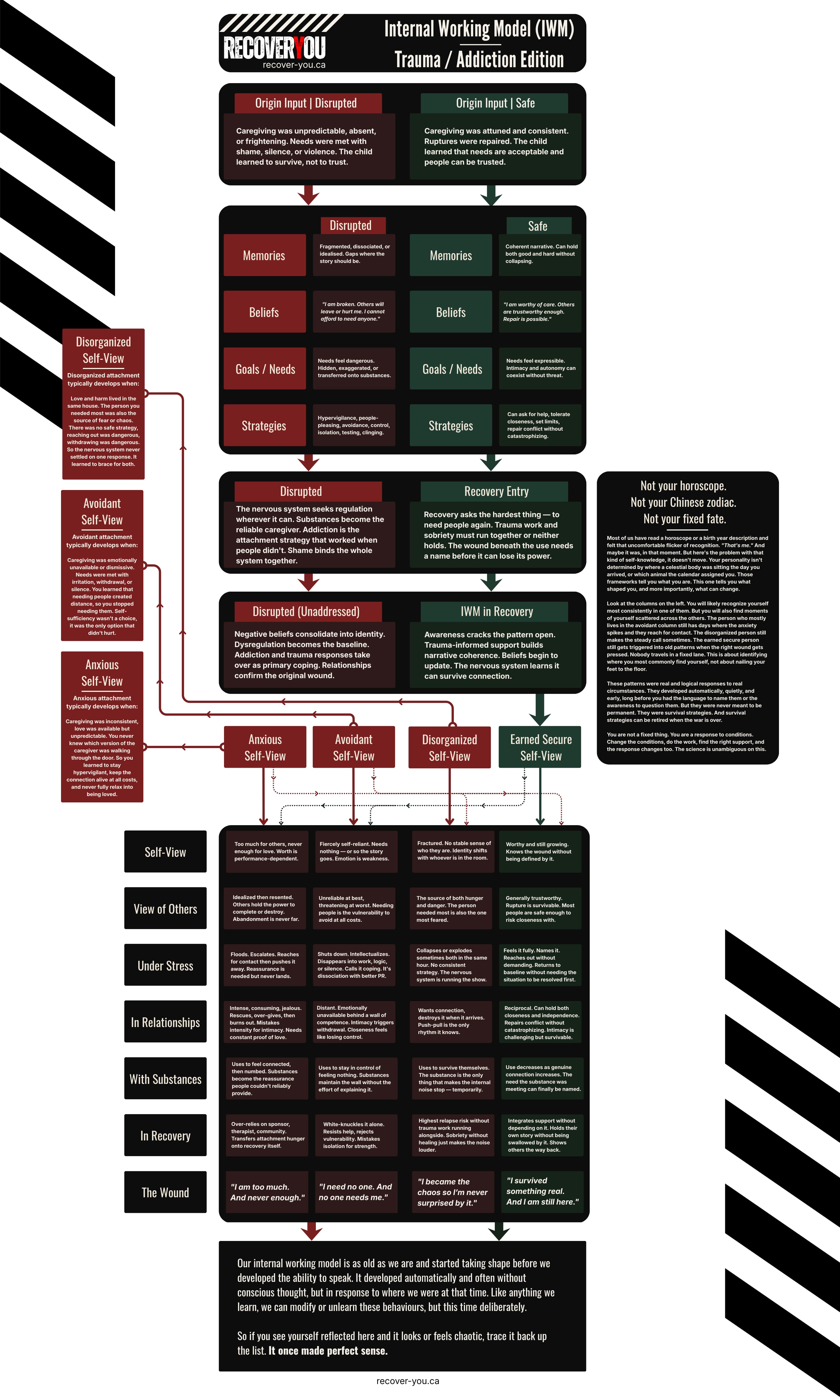
Internal Working Model – Trauma and Addiction Edition framework

Framework

Internal Working Model — Trauma & Addiction Edition

This is a visual map of how your internal working model forms — and how it can change. Built specifically for trauma survivors and those with addiction histories. It gives you a way to trace backwards — from where you are now, all the way to what was likely the origin of the chaos.

Two things it's designed to show you. First, you make sense. You are not the way you are for no reason — every pattern in this framework was a logical response to real conditions. Second, you are not locked in. These are not personality defects. They are survival strategies, and the science on neuroplasticity and attachment repair is unambiguous — they can change.

View Full Framework
Biological Foundations
The Biology of Safety and Connection

Before attachment was a psychological theory, it was a biological necessity. Human infants are born neurologically unfinished — their nervous systems rely on caregivers not just for food and protection, but for regulation. A calm, responsive adult doesn't just comfort a distressed child. They help bring the child's physiology back into balance.

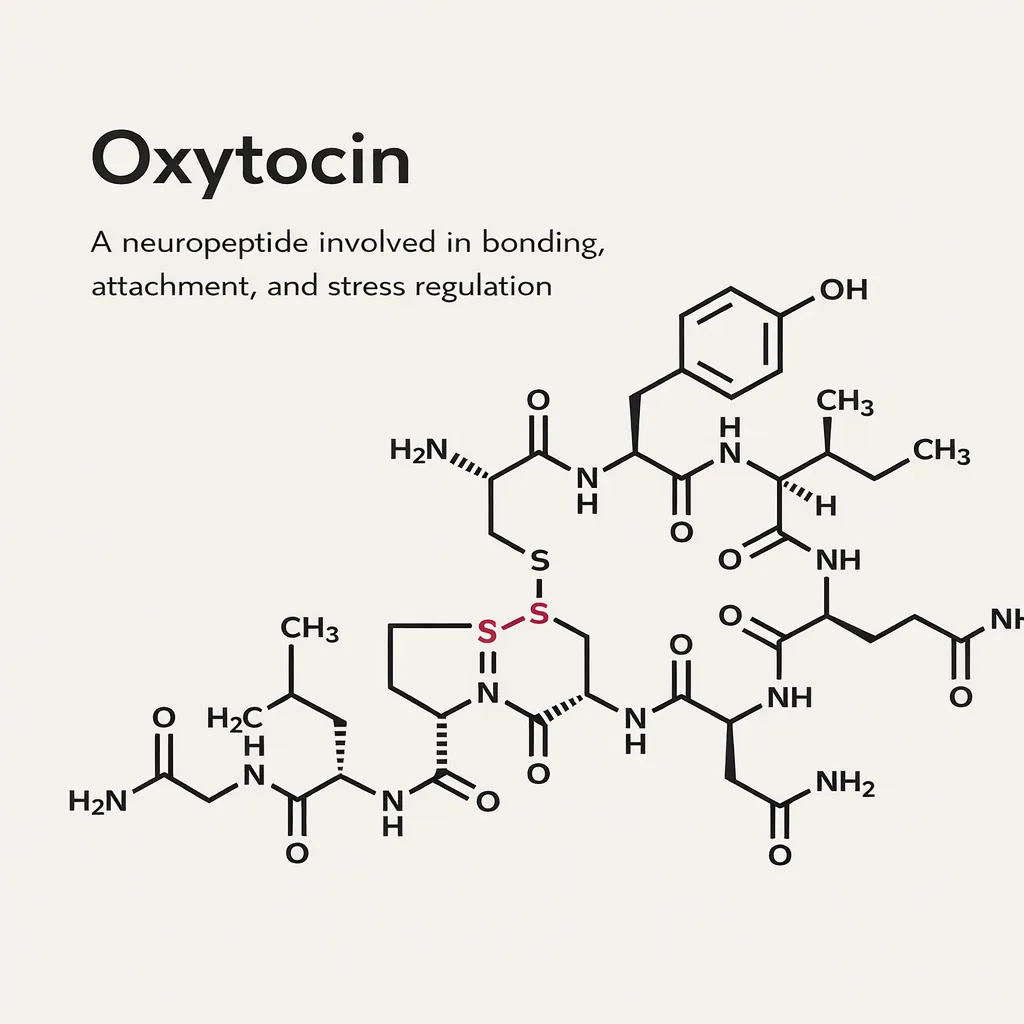
Two systems drive this process. The HPA axis releases cortisol when the brain detects threat. Oxytocin — the brain's bonding neurochemical — helps quiet that response when connection feels safe. When a reliable caregiver soothes a distressed child, oxytocin rises, cortisol falls, and the nervous system settles. Repeated thousands of times, the body learns a rule:

Connection regulates stress.

When early environments are chaotic, neglectful, or frightening, that learning breaks down. Chronic stress keeps the HPA axis activated, flooding the developing brain with prolonged cortisol exposure. Research also suggests early adversity can alter oxytocin receptor expression through epigenetic mechanisms — potentially reducing sensitivity to the very signals that social bonding depends on.

The result is a nervous system wired to seek connection for survival that simultaneously struggles to feel safe within it. The need for people doesn't disappear. The body's ability to experience closeness as regulating may.

This is the biological foundation of insecure attachment — not a theory about relationships, but a record of how the brain's stress and bonding systems were trained during the years they were being built.

Examining:
The 4 Attachment Styles

01 Secure Attachment

Formed when caregivers are reliable, responsive, and emotionally available. These children grow into adults who are comfortable with both intimacy and independence — which sounds almost offensively simple until you realize how rare it actually is. They can say "I need you" without spiraling, and "I need space" without a three-day guilt hangover. They expect relationships to be reciprocal and safe because, early on, they were.

At its core, secure attachment carries one body-level belief: "I'm worthy of care, and other people are generally safe to depend on."

In adulthood, this often looks like:

  • Asking for help without it feeling like a personal failure
  • Trusting that conflict can be repaired — not that it signals the end
  • Feeling basically at home in close relationships rather than waiting for the other shoe to drop

02 Anxious (Preoccupied) Attachment

Born from inconsistency — a caregiver who sometimes showed up with warmth and sometimes simply didn't. The child learns that love is unpredictable and therefore must be constantly monitored, earned, and defended against losing.

The nervous system wires around one quiet terror: if you stop working for it, it disappears. So you don't stop working for it.

As adults, this can look like:

  • Treating a three-hour delayed text as actionable evidence of impending abandonment
  • Needing reassurance so frequently that asking for it starts to feel embarrassing
  • Mistaking emotional intensity and chaos for depth — because calm feels suspiciously like indifference

Underneath all of it is one simple truth: the fear of being left never fully fades — it just changes strategies.

03 Avoidant (Dismissive) Attachment

Formed when a child's needs were minimized, mocked, or ignored. The lesson lands early and hard: vulnerability is weakness, needing people is a liability, and self-sufficiency is the only reliable option.

So the nervous system stops reaching out and starts shutting down instead. Connection becomes something to manage from a safe distance — not something to relax into. Intimacy gets treated like a slow leak: contained, monitored, and never quite allowed to flood the room.

As adults, avoidants often:

  • Dismiss emotional needs with impressive efficiency ("I'm fine, it's not a big deal") — including their own
  • Feel genuinely smothered by what other people call normal closeness
  • Disappear when conflict arrives, then genuinely not understand why that's a problem

What reads as independence is usually a learned self-protection strategy — a way to avoid the specific pain of needing someone who might not show up.

04 Disorganized (Fearful-Avoidant) Attachment

This one develops when the caregiver was both the source of comfort and the source of fear. The nervous system tries to solve an equation that has no solution:

  • "I want closeness, but closeness is dangerous."

Neurologically, it's the amygdala (threat detector) and the nucleus accumbens (reward center) firing simultaneously — the brain screaming "Go!" and "Stop!" at the exact same moment. The result is that trapped, disoriented feeling where love registers as both magnetic and menacing. It is not drama. It is two survival systems running contradictory programs at the same time, with you stuck in the middle wondering why you can't just act normal.

Adults with this pattern may crave connection and panic when it arrives. Idealize a partner one week, find them unbearable the next. Relationships become a tug-of-war between fear of abandonment and fear of engulfment — exhausting for everyone involved, including the person living it.

It's not confusion for the sake of drama. It's a nervous system trying to solve an impossible equation: the person I run to is also the person I have to run from.

Why Attachment Theory Is So Important

Watch: Why Attachment Theory Is So Important Watch on YouTube

A clear breakdown of all four styles — and why adult relationship patterns are usually nervous-system strategies, not personality flaws.

// Attachment: The Hidden Driver
Why your relationship patterns aren't random — they're learned safety strategies

Attachment theory is a map of how your nervous system learned to find safety through — or away from — other people. If closeness felt reliable, you learned to move toward it. If it felt unpredictable, invasive, or absent, your brain adapted. Not because you were broken — because you were surviving the emotional environment you grew up in.

The video covers all four styles practically, and flags something worth knowing: anxious and avoidant partners tend to lock into a cycle — one pursues, the other withdraws, both convinced the other is the problem, both just reacting to threat in opposite directions. Recognizing that loop is usually the first step to breaking it.

The most important takeaway: a secure relationship can feel boring at first — not because it lacks depth, but because it lacks danger. For a nervous system trained on chaos, calm registers as wrong. Healing often means learning to tolerate stability you don't quite trust yet.

"Most people aren't 'bad at relationships' — they're repeating whatever their nervous system learned was necessary to stay emotionally safe."

What this feels like
Not sure where you fit? Notice which of these land:
Anxious Attachment:

(Core fear: abandonment. Substances soothe the panic and chase the closeness.)

  • "Does a three-hour delayed text feel like a five-alarm emergency you need to numb immediately?"
  • "Does your partner's mood determine whether you can stay sober today?"
  • "Do you use to quiet the voice that says you're too much — and about to be left?"
Avoidant Attachment:

(Core fear: engulfment. Substances protect distance and restore the illusion of control.)

  • "Does 'we need to talk' make you want to disappear — or skip straight to getting high?"
  • "Is using alone the only time a relationship isn't asking something of you?"
  • "Does asking for help in recovery feel like a worse failure than the relapse itself?"
Disorganized Attachment:

(Core fear: both. Substances numb the whiplash of 'come here / go away' — the exhausting push-pull that never fully resolves.)

  • "Do you crave closeness — then feel suffocated the moment it actually arrives?"
  • "Do you use to dull the swing between desperately wanting connection and needing to escape it?"
  • "Do you create the chaos — and then use the chaos as the reason you relapsed?"

These patterns are common, well-documented, and — despite how permanent they can feel — highly responsive to the right work.

Attachment and Addiction: Regulating Connection Through Substances

For many of us with disorganized or anxious-avoidant attachment, substances weren't just about numbing pain — they were a way to manage connection itself.

When intimacy felt overwhelming, alcohol or drugs made closeness feel bearable — sometimes, in a twisted way, even safe. When isolation felt unbearable, they filled the gap just enough to quiet the specific ache of being alone without actually having to risk being with someone.

The bottle doesn't judge. The pill doesn't leave. The high creates a sense of control in a nervous system that learned early that emotional connection was chaos. That's not weakness — that's a logical substitution in a system that had run out of better options.

For a long time I didn't understand this about myself. I thought I was using to escape pain. I was — but more specifically, I was using to modulate attachment. To toggle between the two poles my nervous system couldn't navigate any other way:

Numbing the anxiety of closeness

Easing the panic of disconnection

The same wiring follows you into recovery. Wanting support one moment and pushing it away the next. Trusting someone until they get slightly too close — or make one small misstep — and then pulling back completely. It looks like hypocrisy from the outside. From the inside it's a nervous system still trying to find equilibrium in a body that was never taught what safe connection actually feels like. It's not personal. It's not weakness. It's the old program running in new circumstances.

My Reflection:
Living as an Anxious-Avoidant (Disorganized Attachment)

If you put the anxious and avoidant styles in a blender, you'd get me.

I learned to fear closeness and emptiness at the same time. I wasn't afraid of people so much as I was afraid of needing them — because needing someone had never once felt safe.

I want closeness, but when I get it, something in me tightens. Two equally valid but completely opposing parts fight for control at the same time. I start scanning for what might go wrong. When people pull away, I feel rejected. When they move closer, I usually want to run. There is no winning position. There is only the constant low-grade exhaustion of managing a nervous system that can't decide what it actually wants.

Stating boundaries is especially hard for me. Growing up, I learned to take what I could get. Boundaries weren't options — they were luxuries that risked loss. Asking for space or saying "this doesn't feel right" could mean disconnection, anger, or abandonment. So I adapted instead. I bent. I went quiet. I made myself easier to keep.

That wiring still lives in me. When someone crosses a line, I often freeze — caught between two losing options. If I speak up, there's a voice that warns: you could start a fight the relationship can't survive. If I stay silent, I feel violated and resentful. So I sit in the tension and do nothing, while the pressure builds into something that will eventually find its own exit.

When it does, I convince myself I'm taking control. But really I'm just trying to escape the helplessness:

I'll leave you before you hurt me.

It's not paradoxical logic. It's not even logic. Because not choosing to act is still making a choice. It's just a choice made from fear instead of safety — and fear is a terrible navigator.

For years, that's the moment I'd reach for something to take the edge off — not to escape the person, but to quiet the alarm in my body.

These patterns are pre-verbal. They live in the body, not the mind. Mine learned early that connection was both vital and volatile — that love meant proximity one moment and disappearance the next, with no reliable signal for which was coming. That unpredictability wired my nervous system to brace for loss before it ever arrived.

Even now, something as ordinary as a partner not replying to a text for a few hours can feel like a siren going off inside me. For most people it's annoying. For me it can trigger the same physiological panic that once followed my parent's absence — the hollow quiet, the uncertainty of when or whether they'd come back. My chest tightens. My stomach drops. My brain floods with old data that says silence equals danger. It's never about the text. It's about the body remembering what abandonment felt like.

What's helped most is recognizing that both parts — the anxious part that craves reassurance and the avoidant part that fears dependence — are trying to protect me. Neither is wrong. They just learned opposite lessons in unsafe conditions. Knowing that doesn't erase the fear. But it gives me something I never had growing up: a map. I can see the pattern now instead of being swallowed by it. That's not nothing. That's actually where everything else starts.


Healing the Attachment–Addiction Loop

Real recovery isn't just abstaining from a substance. It's learning to tolerate connection without anesthesia.

It means teaching your body — slowly, repeatedly, with more patience than feels reasonable — that safety isn't something you have to earn, perform for, or control. That it can arise naturally, inside you and with the right people around you. Your nervous system won't believe this immediately. That's fine. It doesn't have to. It just has to be shown, enough times, that the evidence accumulates.

I'm nowhere near perfect at this. But I'm better than I was — mostly because I finally understand what I'm working with. For years I had no language for any of it, let alone a path forward. Now I at least know what healing can look like, even if practicing it is a whole different challenge. Every honest conversation, every boundary voiced and respected, every rupture that gets repaired rather than abandoned — each one is a small exposure to safety. Enough of them, and the nervous system starts to update its threat assessment. Slowly. Nonlinearly. But actually.

Healing isn't about becoming fearless. It's about becoming safe enough inside yourself that fear doesn't get to make the decisions anymore.

Why Attachment Work Matters in Recovery

If trauma wired your brain for survival, attachment work rewires it for connection. You can't heal in isolation from the patterns that taught you to fear closeness — because those patterns are running in every relationship you're trying to build your recovery inside of. Building secure attachment — first internally, then externally — is how recovery shifts from white-knuckling sobriety to something that actually feels like freedom.

Because until the nervous system feels safe in connection, addiction will always whisper the same lie:

"You're only safe when you're alone."

The more healthy relationships a child has, the more likely he will be to recover from trauma and thrive. Relationships are the agents of change and the most powerful therapy is human love.

— Bruce D. Perry

Tim Fletcher – Codependency and Attachment Issues in CPTSD

Watch: Tim Fletcher – Codependency and Attachment Issues in CPTSD Watch on YouTube

Tim breaks down how codependency and attachment wounds emerge in those with CPTSD, showing how early relational trauma wires us to seek safety through caretaking, control, or emotional fusion — strategies that make connection feel both essential and dangerous.

// Attachment in Complex Trauma
Why codependency is really an attachment strategy

For many of us with complex trauma, codependency isn’t a character flaw — it’s an adaptation. Tim Fletcher explains how those raised in unpredictable, chaotic, or emotionally neglectful environments learned to survive by staying hyper-attuned to others and disconnecting from their own needs. What looks like people-pleasing on the surface is often an attachment-driven attempt to secure safety and avoid abandonment.

What struck me most was how Tim reframes codependency not as weakness, but as the nervous system’s best available solution when love and danger blur together. It helped me understand why boundaries once felt like betrayal — and why focusing on myself felt selfish even when I was drowning.

He also makes it clear that healing attachment wounds isn’t about cutting people off or finally becoming “independent.” It’s about learning to connect from a place of authenticity rather than fear. That shift — from survival to genuine connection — is the heart of recovery.

“When you grow up needing to earn love or prevent chaos, you start confusing control with care. Codependency isn’t love gone wrong — it’s love learned in survival mode.” — Tim Fletcher

Common Attachment Patterns in Childhood Adversity Survivors

For people who grew up in chaotic or neglectful environments, disorganized and anxious-avoidant patterns are the most common. They reflect a nervous system caught between two survival imperatives:

1. Reach for help.

2. Protect yourself from harm.

In adulthood, that wiring can manifest as:

  • Choosing emotionally unavailable partners
  • Feeling unworthy of stable love
  • Mistaking intensity for intimacy
  • Sabotaging safety because it feels unfamiliar (my personal favorite)

But these aren't character flaws — they're survival strategies that outlived their usefulness. Many of them have a clinical name — and a map for getting out.

// Step 1 — Identify the Pattern
Name the Strategy, Not the "Flaw"

Attachment styles aren't personality defects — they're survival strategies your nervous system designed. Your body didn't default to these patterns because something's wrong with you. It chose them because they kept you safe once. Earned security starts when you can see the loop while you're still inside it.

Anxious: "Closeness = survival. Distance = threat."

Avoidant: "Closeness = loss of self. Space = oxygen."

Disorganized: "I need you desperately — and you terrify me."

The work: catch the reflex before it hijacks the response. Label it as nervous system activation — not a verdict on who you are.

// Step 2 — Soothe the System
Regulate Before You Relate

Attachment responses aren't cognitive errors — they're threat responses. When the nervous system detects danger, higher brain function goes offline and the old script runs automatically. Security is built by teaching your body, repeatedly: "This moment is not that moment."

For anxious activation: interrupt the urgency loop before it sends the text.

Tools: box breathing (4-4-4-4), 5-4-3-2-1 grounding, self-validate before you reach out, 10-minute pause before sending the text.

For avoidant shutdown: stay in the room without flooding.

Tools: name what's happening in your body, take time-bound space ("20 minutes, then I'm back"), make micro-bids for connection, orienting (name 5 things you can see right now).

Regulation isn't repression. It's lowering the volume so you can respond instead of react.

// Step 3 — Practice Secure Actions
Earned Security Is Built Through Repair

Earned secure attachment doesn't mean you stop getting activated. It means you can come back to connection after the rupture — without abandoning yourself in the process. Security isn't a destination. It's a practice built through repetition, honesty, held boundaries, and repair.

State your need clearly: "This is what I'm feeling. This is what would help."

Hold boundaries without abandonment: "I need to step away, but I'm not leaving you."

Repair quickly and imperfectly: own your impact, clear the misunderstanding, reconnect — even when it's messy. Especially when it's messy.

Do this enough times and something shifts: closeness stops feeling like annihilation, distance stops feeling like death, and your relationships stop being run by reflexes you never chose and were never asked to keep. What that shift looks like in practice — especially in recovery — is worth understanding before you get there.

// For Disorganized (Anxious-Avoidant) Attachment
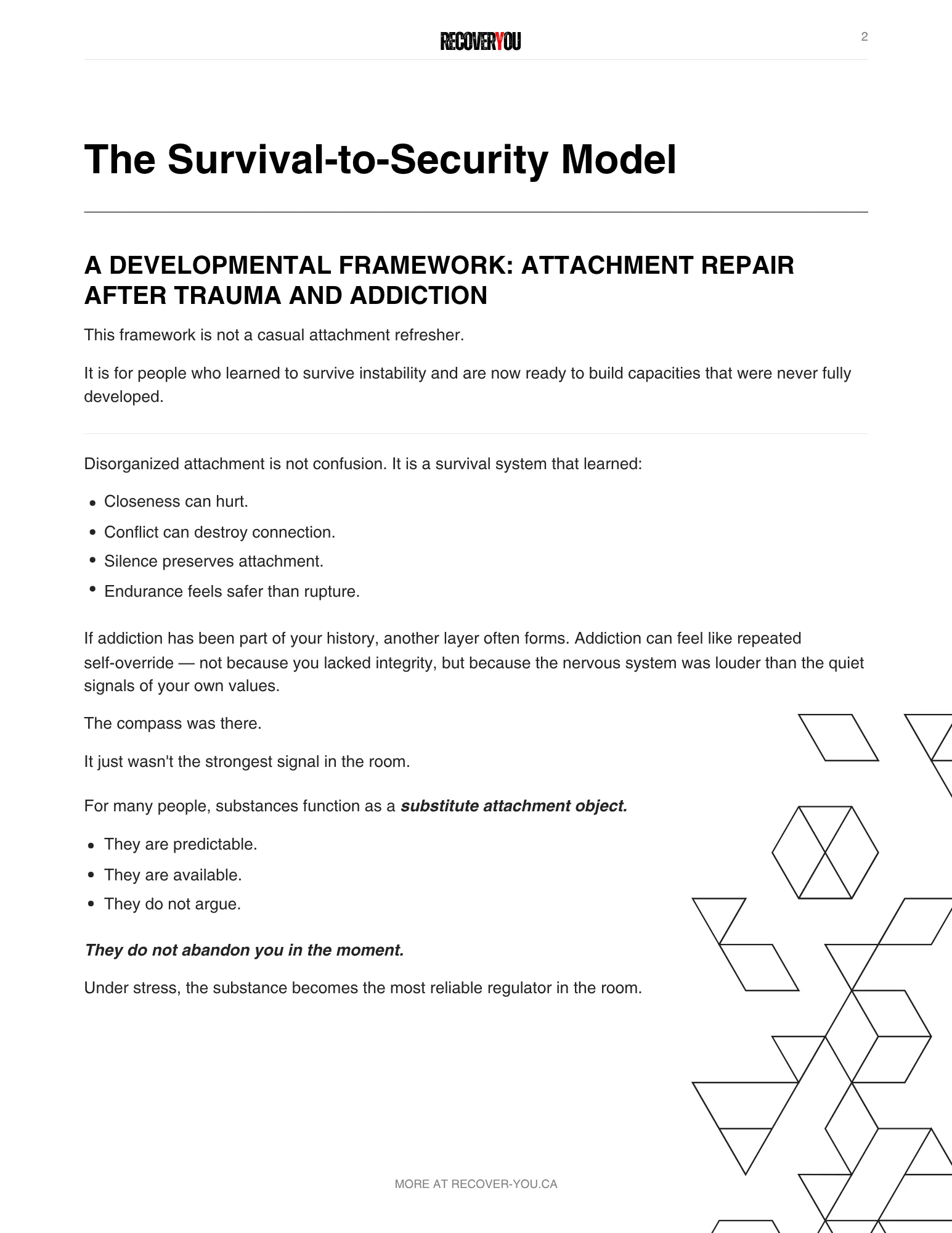
Survival → Security: A Structured Attachment Rewire

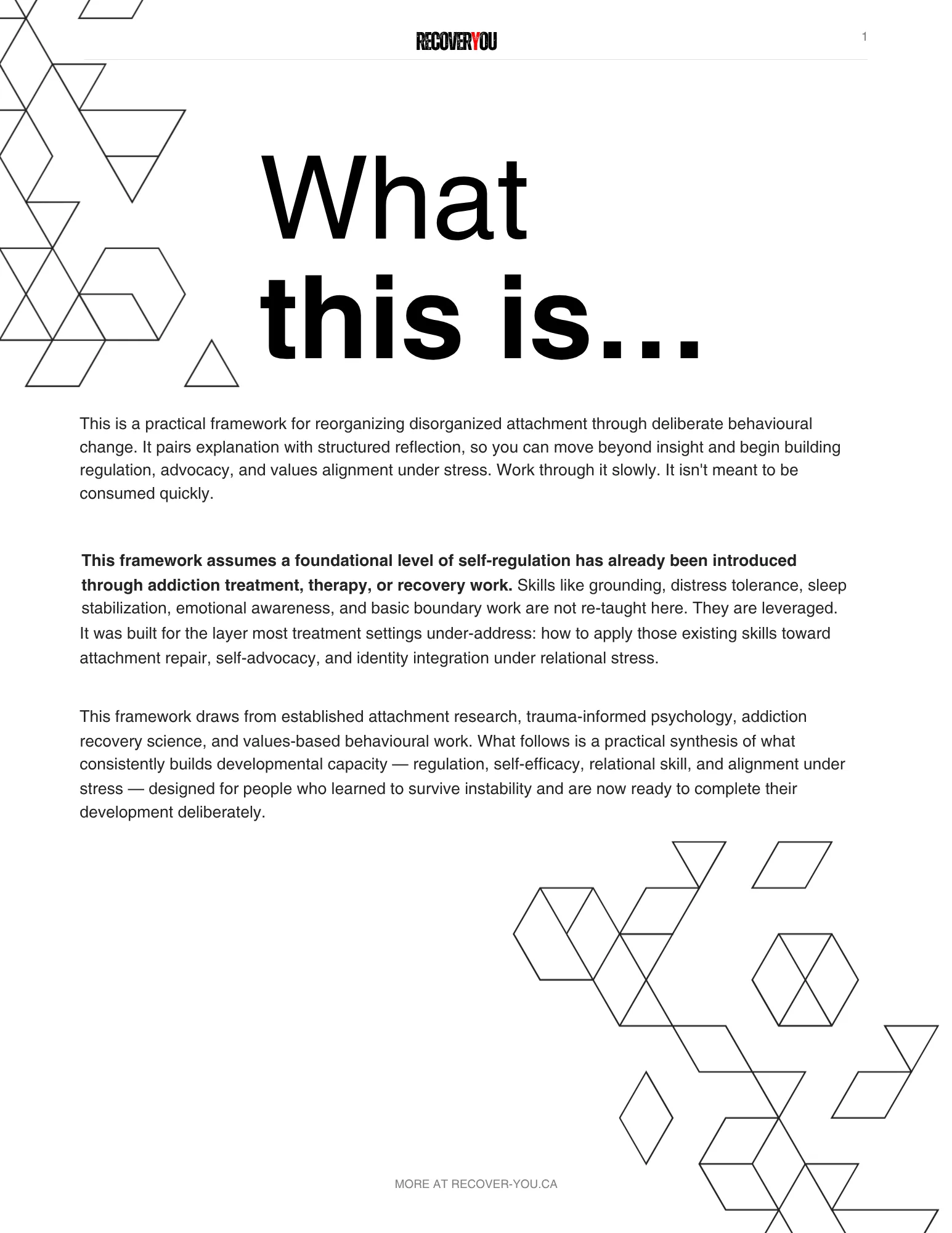
I built this because most programs I attended were missing something: clear, actionable steps for people whose attachment system runs both hot and cold simultaneously — and who are tired of understanding their pattern without knowing what to actually do with it.

Written specifically for disorganized attachment — the push-pull, come-here / go-away wiring that shows up constantly in trauma and addiction recovery. It assumes a basic regulation foundation is already in place (breathwork, grounding, stabilization). This isn't beginner material. It's for people ready to move from understanding the pattern to actively doing something about it.

Survival → Security (PDF)

Built for survivors ready to practice secure connection — not just read about it.

Preview page 1 Preview page 2 Preview page 3

Where to Next?

Follow the next step in order, or branch out into related topics.

Sources + Further Reading
  1. Bowlby, J. (1988). A Secure Base: Parent-Child Attachment and Healthy Human Development. Basic Books. Classic overview of how the caregiver functions as a secure base and how early attachment becomes the biological and psychological foundation for later mental health — directly tied to this page’s framing of safety, not love alone, as the core of attachment. View on Goodreads
  2. Bowlby, J. (1969). Attachment and Loss, Vol. 1: Attachment. Basic Books. Introduces attachment as a biologically based survival system and the idea of the Internal Working Model — the mental blueprint this page describes as the pre-verbal map of self, others, and safety that later adult relationships follow. View on Internet Archive
  3. Ainsworth, M. D. S., Blehar, M. C., Waters, E., & Wall, S. (1978). Patterns of Attachment: A Psychological Study of the Strange Situation. Lawrence Erlbaum. Strange Situation research that empirically identified secure, anxious/ambivalent, and avoidant patterns in infancy — the foundation for the four-style framework this page extends into anxious, avoidant, and disorganized adult attachment. Find via WorldCat
  4. Hazan, C., & Shaver, P. (1987). Romantic love conceptualized as an attachment process. Journal of Personality and Social Psychology, 52(3), 511–524. Extends attachment theory into adult romantic relationships, showing that early attachment patterns map onto adult styles of pursuing, clinging, or distancing — grounding this page’s claim that your relationship patterns are nervous-system strategies, not random personality quirks. View on PubMed
  5. Main, M., Kaplan, N., & Cassidy, J. (1985). Security in infancy, childhood, and adulthood: A move to the level of representation. Monographs of the Society for Research in Child Development, 50(1–2), 66–104. Shows that adults’ own attachment representations predict their children’s attachment classifications — the empirical backbone for this page’s discussion of how attachment patterns and “blueprints” transmit across generations. View on PsycNet
  6. Main, M., & Hesse, E. (1990). Parents’ unresolved traumatic experiences are related to infant disorganized attachment status. In M. Greenberg, D. Cicchetti, & E. M. Cummings (Eds.), Attachment in the Preschool Years. Links caregivers’ unresolved trauma to disorganized attachment in their children — supporting this page’s point that chaotic early care wires the system to both reach for and fear closeness, and that these patterns are often intergenerational. View record
  7. Main, M., Kaplan, N., & Cassidy, J. (1985). Security in infancy, childhood, and adulthood: A move to the level of representation. Monographs of the Society for Research in Child Development, 50(1–2), 66–104. Shows that adults’ own attachment representations predict their children’s attachment classifications — the empirical backbone for this page’s discussion of how attachment patterns and “blueprints” transmit across generations. View supporting research on PMC
  8. Schore, A. N. (2001). The effects of early relational trauma on right brain development, affect regulation, and infant mental health. Infant Mental Health Journal, 22(1–2), 201–269. Details how early attachment disruptions alter right‑brain development and stress regulation systems — giving the neurological basis for this page’s description of attachment as “the biology of safety” and for the idea that chaotic care wires the nervous system for hypervigilance. Full PDF (author site)
  9. Siegel, D. J. (1999). The Developing Mind: How Relationships and the Brain Shape Who We Are. Guilford Press. Integrates attachment theory with neuroscience, showing how early relational experiences become implicit, body‑level templates — supporting the page’s language about “embodied patterns” that fire faster than conscious thought and run adult relationships under stress. View on Goodreads
  10. Flores, P. J. (2004). Addiction as an Attachment Disorder. Jason Aronson. Clinical text arguing that insecure attachment creates vulnerability to using substances as a substitute secure base — directly echoing this page’s framing of alcohol and drugs as a “replacement attachment figure” when people feel safer with a bottle than with other humans. View on Goodreads
  11. Carnes, P. (1997). The Betrayal Bond: Breaking Free of Exploitive Relationships. Health Communications. Describes trauma bond dynamics, where exploitation is misread as intimacy and the body resists leaving what it was conditioned to need — backing this page’s discussion of why leaving unsafe relationships can feel more threatening than staying. View on Goodreads
  12. Walker, P. (2013). Complex PTSD: From Surviving to Thriving. Azure Coyote. Clinically informed guide to C‑PTSD, the 4F responses, and fawn/people‑pleasing as survival strategies — providing additional context for this page’s description of codependency and attachment strategies as adaptations rather than character defects. Access author site
  13. Koob, G. F., & Volkow, N. D. (2010). Neurocircuitry of addiction. Neuropsychopharmacology, 35(1), 217–238. Summarizes the reward–stress–craving circuitry of addiction — supporting this page’s link between attachment wounds, stress systems, and why substances can come to feel like the only reliable regulator for an attachment‑injured nervous system. View on PubMed    Free full text

These sources span classic attachment theory, developmental neuroscience, and clinical work on addiction and trauma bonds, grounding this page’s claim that relationship patterns are survival strategies wired into the nervous system rather than fixed personality flaws. They are educational and not medical advice.

Feeling overwhelmed by what you’ve read? Support is here • Call 988 Anywhere in Canada 24/7 Suicide Crisis Line • In Alberta call 211 (community & mental health referrals) • Distress Line 780-482-HELP • 911 in emergencies