 TRAUMA AVOIDANT

Trauma “Avoidant”
When “trauma-informed care” becomes avoidance in a softer accent
This page is a critique of systems: the frameworks, funding structures, and institutional defaults that shape how addiction care gets delivered. It is not a critique of the people working inside them.
I owe my life to many of those people. Counsellors, caseworkers, nurses, intake workers, and peers who showed up with more care than their job descriptions ever asked of them. I've also watched some of them carry a grief I wouldn't wish on anyone: losing a client after watching them complete treatment. That kind of heartbreak doesn't leave a person. I've seen it in their faces. It stays.
The people inside these systems aren't the problem. In many cases, they're the only thing standing between someone and the floor. This critique is for them as much as anyone. They deserve better tools, better frameworks, and systems that give their care somewhere to actually connect and improve a clients trajectory.
The fact that any of this is hard to say out loud is precisely why it has to be said.
The Hollow Label
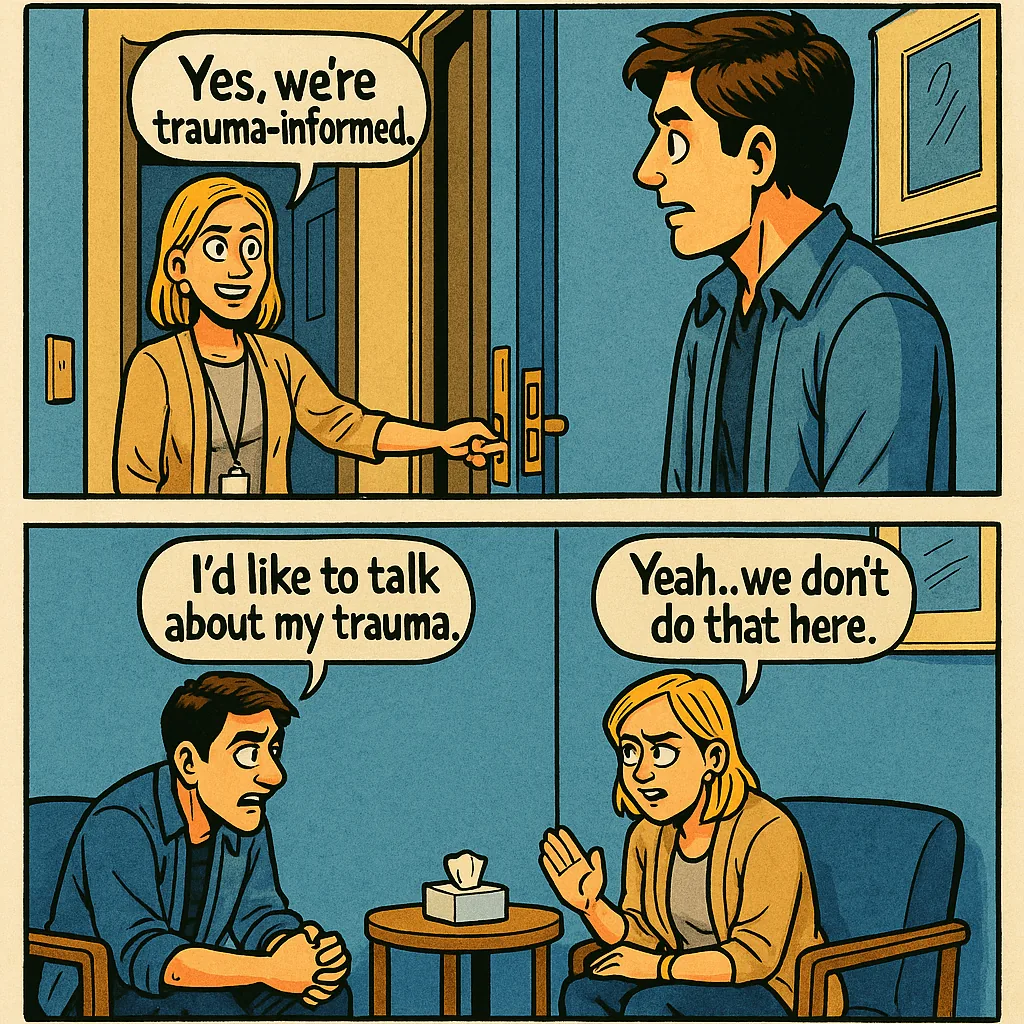
"Trauma-informed care" has become one of the most repeated phrases in addiction treatment, and one of the least meaningful. Most programs carrying the label aren't trauma-informed. They're trauma-avoidant. And the people running them usually know it.
For anyone trying to heal from addiction, that isn't a minor gap in service delivery. A facility that doesn't offer trauma-specific therapy, or a clear pathway toward it, isn't treating the condition. It's managing the symptoms while the wound stays open. That's not care. That's containment.
What makes this particularly hard to excuse is that adopting trauma-informed language is itself a formal admission. When a treatment centre designates a program as trauma-informed (training staff in trauma principles, updating intake language, building policy around it), it is officially acknowledging that the population it serves is traumatized. That acknowledgement is on the record. It's in the frameworks they signed onto. It's in the room.
And yet the pathway to actual trauma processing, the therapy that addresses what the acknowledgement names, is routinely absent. Underfunded. Referred out with no real coordination. Or deferred until "after stabilization," which for many people never arrives.
The institution has looked at the wound, documented the wound, built policy around the existence of the wound, and then declined to treat it. That isn't a service gap. It's a contradiction inside the system's own stated framework. It fails on its own terms.
There are excellent centres that genuinely integrate trauma and addiction work, and they're worth seeking out. But they remain the exception in a field still more comfortable polishing the surface than examining what's underneath it.
If a "trauma-informed" facility doesn't offer trauma-specific therapy, or a clear and accessible pathway toward it, it isn't trauma-informed.
Full stop.
The Core Driver of Addiction Isn’t the Substance
For trauma survivors, this was never just about bad choices. It was about pain deep enough that escape felt worth any consequence.
After more than two decades in active addiction and thousands of conversations with people in use and in recovery, one pattern held steady: unresolved emotional pain, especially childhood trauma, is one of the most significant drivers of addiction. Not a contributing factor. A driver.
Estimates suggest 75–90% of people in substance use treatment report histories of trauma. That isn't coincidence. That's signal. (Including adverse childhood experiences: learn more here.)
source: Substance Abuse and Mental Health Services Administration (SAMHSA)
One person can try a drug and walk away. Another spirals. The difference isn't willpower. It's whether there's a wound deep enough that escape feels worth the cost.
Even the “Rat Park” Experiment Missed a Piece
If you're like me and you've spent enough time in recovery spaces, you've undoubtedly run into the Rat Park experiment, or at least the famous TED Talk built on it. It gets passed around like gospel, and to be fair, it earned the airtime. But sit with it long enough and you start to notice what it leaves out.
Before Rat Park, early addiction research was brutally simplistic. A single rat in a barren cage was given two bottles: one with water, one with a drug like morphine or cocaine. Predictably, the rat kept choosing the drug until it died. I doubt the researchers saw it this way at the time, but that wasn't an addiction experiment. It was a controlled study in despair.
Rat Park added nuance. In the original experiment, both isolated and socially housed rats were exposed to morphine for an extended period. When given a choice between morphine and water, the rats living in the enriched social environment consumed significantly less morphine than the isolated rats. Importantly, their drug use didn't disappear. It decreased. That distinction matters. Rat Park didn't show that connection makes addiction vanish. It showed that connection and environment can meaningfully influence drug consumption.
But Rat Park only changed the current environment. It didn't touch the internal world of the animals. It didn't ask about early adversity, fear conditioning, or the nervous system damage accumulated long before the experiment began. That layer was never examined. And that layer is the one that matters most for understanding addiction in human beings.
Rat Park corrected the environment. It never examined motive. It assumed drug use rises when connection is absent and falls when connection is restored. Often, that's true. But it leaves an unanswered question sitting at the centre of the whole model:
What if the drive to numb predates the cage entirely?
What if the organism enters the experiment with a nervous system already sensitized by chronic threat, not because of what's happening now but because of what happened then? What if the substance isn't chosen because the present feels empty, but because the internal state is unbearable no matter what the present looks like?
Put it in human terms and the gap gets uncomfortable fast. Did that rat grow up in an addicted household? Was it abused by the people who were supposed to protect it? Did it witness violence it couldn't escape or make sense of? Was it left alone with a fear it had no words for? Nobody knows, because nobody asked. Laboratory rats are bred in standardized colonies for the express purpose of eliminating that kind of variation, and the study never measured early-life adversity in a single animal. That whole domain, the one that matters most in human addiction, was designed out of the picture before the experiment began. You cannot test a variable you've deliberately held constant, and you cannot theorize about one you never measured.
-
Varied
Housing and social environment
Isolated cage against the enriched colony. This is the thing Rat Park changed, and what it found there was real.
-
Held constant by design
Genetic and developmental background
Laboratory rats are bred in standardized colonies for the express purpose of eliminating that variation.
-
Never measured
Early-life adversity
Not recorded in a single animal — and in human addiction, the layer that matters most.
Study design, not results. This describes what the Rat Park experiments manipulated, what was standardised out before they began, and what was never recorded — it reports no finding and measures nothing. The reading is this page’s own.
This is what we rarely ask: not what conditions surround the behaviour, but what internal pain the behaviour is regulating. Early adversity wires hypervigilance. Chronic unpredictability lowers the threshold for stress. Attachment rupture teaches the body that safety is unstable. When those things happen early enough and go unaddressed long enough, the substance stops being a reaction to the environment. It becomes the only available answer to an internal state that nothing in the outside world has ever reached.
Rat Park never addressed motive.
A beautiful cage doesn't erase the need to numb inner torment.
Rat Park revealed an essential truth. Connection matters. Environment matters. What it didn't account for is the person who carries their internal landscape into every environment they enter, including the enriched one. External conditions can support recovery. They can't do the internal work. And for survivors of early trauma, the internal work is where it starts.
When the Real Pain Finally Surfaces
The most honest moments I've experienced in treatment didn't happen in group or in a therapist's office. They happened quietly and unceremoniously, late at night or tucked off in a corner somewhere, between people who had built enough trust to mean it. There's a point where words stop being managed. An unspoken understanding settles, and both of you decide it's safe enough to tell your truth:
- "I've never told anyone this before."
- "I know it wasn't my fault, but it still feels like it."
- "I don't think I'll ever truly be okay."
Sometimes what comes out is almost unbearable to hear. Stories of emotional, physical, or sexual abuse. People hurt by strangers, parents, friends, partners. People who witnessed or endured things no one should ever have to.
And when the truth finally surfaces, it's astonishing, in retrospect, to see how close we really were without knowing it. In those moments we were already ninety percent there and completely oblivious: standing at the threshold, the point where real work could begin if someone knew how to catch it. But no one does. So it passes. And what could have been a breakthrough becomes what it always does: two hopeless, uninformed addicts swapping war stories in the dark.
"Are you going to talk to someone about it?"
Nine times out of ten, the answer is some version of: "Screw that, I don't want to talk about that shit."
And the tenth? They'll say yes. Not because they mean it, but because they want the conversation to end.
We get defensive, and why wouldn't we? When someone asks if we're going to "talk to someone" about our deepest wounds, it can feel invasive, even threatening. It isn't arrogance; it's protection. Of course we shut down. Especially when we don't have a damn clue where to take it, or what the very real cost of leaving it buried actually is.
The only reason I finally faced mine was education: being lucky enough to learn the science of how unprocessed trauma keeps the body and brain locked in survival mode. Knowledge gave it shape. It turned avoidance into something I could actually work with.
We can't, and shouldn't, force anyone to relive their trauma.
But treatment centres fail critically when they don't teach why processing trauma is essential to recovery. If someone had shown me the science, the studies, the data, the actual evidence, I believe I would have faced it sooner. Recovery culture is saturated with spirituality, metaphor, and cliché. It's easy to say "I get it" when you don't, and no one is the wiser. Maybe not even you. You can echo the right phrases. You can spin a compelling story. You can look like someone doing the work without doing any of it. But real evidence, once you actually understand it, is harder to outrun. It takes away the comfortable ambiguity. It makes the cost of continued avoidance visible in a way stock phrases never could. And that's exactly what treatment centres should be putting in the room.
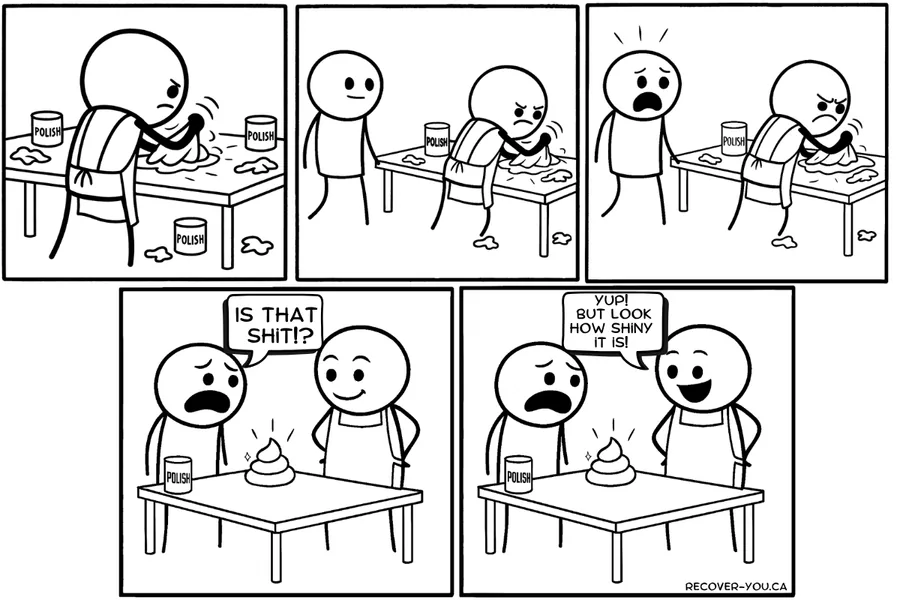
If people believe they can keep shoving it down, they will. Until the weight of what's buried pulls them back under.
Trauma-avoidance isn't compassion.
It's abandonment dressed as care.
Addiction is neither a choice nor an inherited disease, but a psychological and physiological response to painful life experiences.
— Gabor Maté, In the Realm of Hungry Ghosts (2008)
When Nobody Asks About the Beginning
Across detoxes, inpatient stays, outpatient programs, and psychiatric assessments, not once did anyone ask the most basic question:
"Tell me about your life."
I sat through intakes that ran for hours. The focus never changed: how much, how often, how long. Charted. Documented. Categorised. That was the entire picture they wanted.
It felt like being read the way you'd read a volatile stock. Someone tracking the price action of a human life without once asking what was driving it. Nobody looked at the early conditions, the instability, the nervous system shaped long before the first drink. They had the numbers. No one asked about the whole person.
Context forced its way in accidentally. When you walk through your use chronologically, you remember what was happening around it. The breakup. The chaos. The fear. The event always comes with the substance. That should matter.
But the system didn't stay there. It went back to the numbers. Even when medications were prescribed (antidepressants, anti-anxiety meds, stimulants), trauma was treated as interference. The whole signal, filed under background noise, unless I forced it into the room myself.
When no one asks about the beginning, the pattern becomes the diagnosis. For people like me, the beginning is the story.
The DSM-5 (learn more here) doesn't ask why.
It measures symptoms. Not context.
It can label my behaviour. It can't explain my pain.
What I’ve Witnessed Firsthand
For years I couldn't understand why my friends could stop after a night out while I kept disappearing for days. What I eventually had to accept, and what nearly cost me my life before I did, was that they weren't escaping anything. I was. For them, the hangover outweighed the fun. For me, the escape outweighed the crash. Every. Single. Time.
- "I didn't feel safe as a kid."
- "I had to raise myself."
- "I was punished for showing emotion."
- "I was abused and couldn't stop it."
- "I hated going home."
These weren't unusual disclosures. They were nearly universal. In room after room, across years of treatment and recovery, the same story kept surfacing in different words. Addiction is often the medication for wounds that never healed.
The Dangerous Logic of “Trauma-Informed” Care That Avoids Trauma
In practice, "trauma-informed" usually means some combination of this:
-
Practice 01
Gentler Language
- Staff trained to communicate with more sensitivity and care
- Softer framing around difficult topics
- Language that acknowledges trauma exists, without ever addressing it
-
Practice 02
A Calmer Environment
- Less chaos, cleaner spaces, more predictable structure
- Environments designed not to retraumatize
- Safety as a setting, not a therapeutic outcome
-
Practice 03
A Policy of Not Digging
- Clients aren't forced to revisit trauma, a vital protection
- But "not forced" quietly becomes "never invited"
- And "never invited" becomes the default end of the conversation
-
The Gap
What's Missing
- A clear, funded pathway to trauma-specific therapy
- Clinicians trained and resourced to do trauma processing, not just trauma awareness
- Any answer to the question: what happens after we acknowledge the wound?
These are meaningful steps. But when "trauma-informed" becomes a reason to avoid trauma entirely, the label stops describing the care and starts covering for the absence of it.
If unresolved trauma fuels relapse, how can tiptoeing around it be justified? Not naming it doesn't protect people. It abandons them with the same wounds that drove them to substances in the first place.
This avoidance isn't always deliberate. Some of it is under-resourcing. Some of it is real uncertainty about how to hold what comes up. But I can't help wondering about the reasons that are harder to name:
- 01Are some staff simply not equipped to hold what surfaces when the door actually opens, and does the system know it?
- 02Are some centres keeping trauma outside the scope of practice, not out of uncertainty but out of liability?
- 03Does the cost of real trauma treatment make it easier to stop at "trauma-informed" and call that close enough?
I don't have clean answers to those questions. But they're worth sitting with, because whatever the reason for the gap, the consequence doesn't change. Good intentions don't heal pain. Pain left unaddressed becomes relapse waiting to happen.
If a treatment centre claims to focus on "what happened to you," there has to be a clear, accessible pathway to clinical, trauma-specific therapy. Without it, it's marketing language wrapped around avoidance.
Where Are the Real Trauma Supports?
These are the questions the system should be answering. The fact that it isn't answering them is not an oversight. It's a choice.
- Where are the trauma-specific support groups inside treatment centres? Not "process groups," but spaces actually designed for what trauma survivors are carrying.
- Where is consistent, funded access to proven trauma treatments like EMDR, ART, and IFS, therapies that address the root, not just the symptom?
- Where is the public funding for trauma healing instead of another round of revolving-door detox that sends the same people back through the same doors with the same wounds?
Until those questions get real answers, treatment will keep failing the very people it claims to serve. Not missing the mark. Failing them. The ones using substances not to party, but to survive unbearable pain.
These questions weren't being asked out loud. That's why this site exists.
The Mission
The Mission of Recover-You
Recover-You exists because behaviour management isn't recovery. Because polishing the surface isn't compassion. It's a way of avoiding the work while still collecting the credit.
Lasting recovery requires going to the root. This site exists so the next person doesn't have to wait as long as I did to find out what the root actually is.
Survivor-made • Science-backed • Alberta-informed
Where to Next?
Follow the next step in order, or branch out into related topics.
- SAMHSA. (2014). SAMHSA's Concept of Trauma and Guidance for a Trauma-Informed Approach. HHS Publication No. (SMA) 14-4884. The federal policy document that defined trauma-informed care and established its Six Key Principles: the framework this page argues has become widespread in its language but inconsistent in its depth, often functioning as organisational posture rather than actual trauma resolution. Download PDF
- Edelman, N. (2023). Doing trauma-informed work in a trauma-informed way: understanding difficulties and finding solutions. Health Services Insights, 16. Contemporary paper documenting the gap between trauma-informed care as a policy commitment and its actual implementation, examining why practitioners trained in trauma-informed principles still struggle to deliver it, and what structural conditions are required for it to function as designed rather than as a risk-management framework. View on PMC
- Harris, M., & Fallot, R. D. (Eds.). (2001). Using Trauma Theory to Design Service Systems. Jossey-Bass. The foundational text introducing trauma-informed service design, and one of the earliest articulations of the distinction this page makes: that trauma-informed systems create conditions for disclosure and avoid retraumatization, but do not themselves constitute trauma treatment. View on Goodreads
- Felitti, V. J., Anda, R. F., et al. (1998). Relationship of childhood abuse and household dysfunction to many of the leading causes of death in adults. American Journal of Preventive Medicine, 14(4), 245–258. The original ACE Study, establishing that early adversity is pervasive, its effects are dose-dependent and lasting, and that systems treating only symptoms while leaving underlying trauma unaddressed are working against their own outcomes. View via DOI
- Najavits, L. M. (2002). Seeking Safety: A Treatment Manual for PTSD and Substance Abuse. Guilford Press. Developed specifically because standard SUD treatment was failing trauma survivors, documenting that addressing the substance while leaving trauma unprocessed leaves the core driver intact and increases relapse risk. A direct clinical argument for moving beyond avoidance into structured processing. View on Goodreads
- Ford, J. D., & Courtois, C. A. (2014). Complex PTSD, affect dysregulation, and borderline personality disorder. Borderline Personality Disorder and Emotion Dysregulation, 1(1), 9. Documents the clinical and neurobiological distinction between C-PTSD and single-incident PTSD, establishing why generic trauma-informed approaches designed for simpler presentations frequently fail complex trauma survivors, and why avoiding trauma-specific care produces the misdiagnosis and treatment dropout patterns this page describes. View Article
- Van der Kolk, B. A. (2014). The Body Keeps the Score: Brain, Mind, and Body in the Healing of Trauma. Viking. Seminal synthesis of trauma neuroscience, documenting how trauma is stored somatically and why systems that manage behaviour without addressing the underlying neurological state are more likely to produce accommodation than resolution. Central to this page's argument that trauma-avoidant care, however well-intentioned, falls short of durable healing. View on Goodreads
- Briere, J., & Scott, C. (2015). Principles of Trauma Therapy: A Guide to Symptoms, Evaluation, and Treatment (2nd ed.). SAGE Publications. Comprehensive clinical reference covering the full spectrum of trauma-informed assessment and treatment, including the distinction between stabilization-focused and processing-focused approaches, and why both are necessary components of a complete model rather than alternatives. View on Goodreads
- Chadwick, M., et al. (2022). Barriers to delivering trauma-focused interventions: a meta-review. Frontiers in Psychology, 13. Meta-review documenting the systemic, training, and resource barriers that prevent trauma-focused treatment from being delivered even when clinicians recognise its necessity, contextualising this page's critique as systemic rather than individual: trauma-avoidant care is often structural, not a failure of intention. View on PMC
These sources highlight the evolution of trauma-informed care, the documented gap between its principles and its implementation, and why moving from accommodation to actual trauma processing is the necessary next step for systems serious about durable recovery outcomes. Educational only, not medical advice.