 FALLS SHORT

Why Traditional Treatment Often Falls Short
You’re Not Broken. The Model Is Incomplete.
// I did everything right. Got sober. Followed the program. I was certain sobriety was the answer. It wasn’t. Not even close.
The first time I entered inpatient treatment, I believed the problem had a name and the name was alcohol. It was the most visible thing in a life full of wreckage, so I assumed removing it would let everything else settle back into place.
For a while, it looked like it had. Clear-headed. Optimistic. Repairing relationships, rebuilding finances. I fell in love with Calgary during treatment, found work, relocated from Edmonton. From the outside, I was a success story.
Inside, I was quietly coming apart.
What followed was the worst relapse of my life. It nearly killed me, and it came close to destroying every relationship that mattered. In hindsight, it was never a question of if. Only when. Alcohol was never the problem. It was the solution. Crude and borrowed, but mine. Without it, I was exposed. Decades of unprocessed pain with no container and no tools. I had stripped away the symptom and left the cause completely untouched. Not because I failed. Because no one ever told me there was a cause.
This is the gap traditional treatment so often leaves open. It stabilizes, educates, and supports. For many people, that's genuinely life-saving. But for trauma survivors, stability is not the same as recovery. When the substance is removed, we don't return to a healthy baseline. We return to the trauma, the dysregulation, the unresolved grief. Only now without the thing that once made it survivable.
When treatment doesn't reach what's underneath the addiction, sobriety doesn't feel like freedom. It feels like standing in a burning building with the fire alarm finally silenced.
// What Traditional Treatment Actually Does
To be clear: most addiction programs do what they're designed to do, and they do it well. The priority is immediate and correct. Help a person stop using and regain enough stability to function. The structure, the medical oversight, the peer support. These things save lives. I wouldn't be writing this without them.
Where these programs struggle isn't in what they do. It's in what they don't ask. They're built to manage behaviour in the present, not to understand where it came from. They restore functioning: sleep, nutrition, routine, accountability. They teach addiction science and relapse prevention. They give people a fighting chance at the first 30 days. But the origins of the behaviour, the nervous system that learned to need the substance, rarely enter the room.
The pillars below represent what most treatment centres actually offer. Each one is legitimate. The problem isn't any individual piece. It's what the model, as a whole, consistently leaves out.
-
01
Detox & Stabilization
Supporting withdrawal safely, monitoring vital signs, and helping the body re-establish basic physical stability. This is where sleep, appetite, hydration, and nervous-system regulation begin to recover.
-
02
Education & Relapse Prevention
Teaching how substances affect the brain, identifying high-risk situations, understanding triggers, and learning practical skills like “urge surfing,” delay strategies, and building healthier routines.
-
03
Group Therapy & Peer Support
A structured space for sharing experiences, building accountability, practicing communication skills, and creating a sense of connection with others who understand the struggle firsthand.
-
04
12-Step or Faith-Based Programs
Encouraging self-reflection, accountability, spiritual growth, and community. These frameworks offer structure and consistency, and for many, a sense of belonging and meaning.
-
05
Aftercare Planning
Creating a plan for ongoing support: therapy, meetings, structure, habits, and accountability. The goal is maintaining progress once the protected environment of treatment ends.
-
06
Medication Management
Using medications to reduce cravings, ease withdrawal, stabilize sleep, and support mood. Often essential tools for early recovery and maintaining stability.
-
01
Trauma Processing & Integration
Safe, evidence-based approaches to reprocess overwhelming memories, so the past stops intruding on the present.
-
02
Nervous System Regulation
Learning tools to calm an overactive stress response and shift the body out of chronic fight-or-flight.
-
03
Attachment & Trust Repair
Relearning safety in connection. Building the capacity to trust, depend, and be depended on.
-
04
Identity & Self-Worth Rebuilding
Reconstructing a sense of self that isn’t built around survival, performance, or self-protection.
-
05
Shame & Self-Compassion Work
Shifting from self-blame to self-understanding. Rebuilding the ability to see yourself as worthy.
-
06
Body-Based Therapies
Using EMDR, ART, somatic therapy, yoga, or other modalities to release trauma held in the body, not just the mind.
Most addiction programs focus on stabilizing behaviour. But childhood trauma survivors carry an entirely different set of challenges beneath the surface. We don't just manage cravings. We're living with fear, shame, hypervigilance, and a stress system that never learned how to turn itself off.
Sobriety removes the substance. It doesn't automatically repair the dysregulation that made escape feel necessary in the first place. In my case, when the underlying pain wasn't addressed, being sober often felt worse than using. I never admitted that out loud. For many of us, recovery isn't just about abstinence. It's about safety, understanding, and learning how to calm a brain that has been in survival mode for decades.
// Typical Addiction Model
-

Healthy Brain.
A balanced system. Emotion, reason, and reward working in sync.
- Amygdala fires at real threats, then powers down
- Stress response turns off when danger passes
- Prefrontal cortex regulates impulses and aligns actions with values
- Dopamine rewards authentic pleasure and motivation
- Balance fosters trust, curiosity, and resilience
-

The Brain Under Addiction
(Without Trauma History).Reward circuitry hijacked. The substance becomes the system's primary reference point for relief.
- Dopamine loops fixate on substances/behaviors
- Absence of the drug feels like a threat
- Stress response stays overactive, driving craving
- Prefrontal control weakens, impulse overrides values
- Daily life narrows to seeking and escape
// Now add trauma. The same circuitry. A different story underneath.
// Trauma & Addiction Model
-
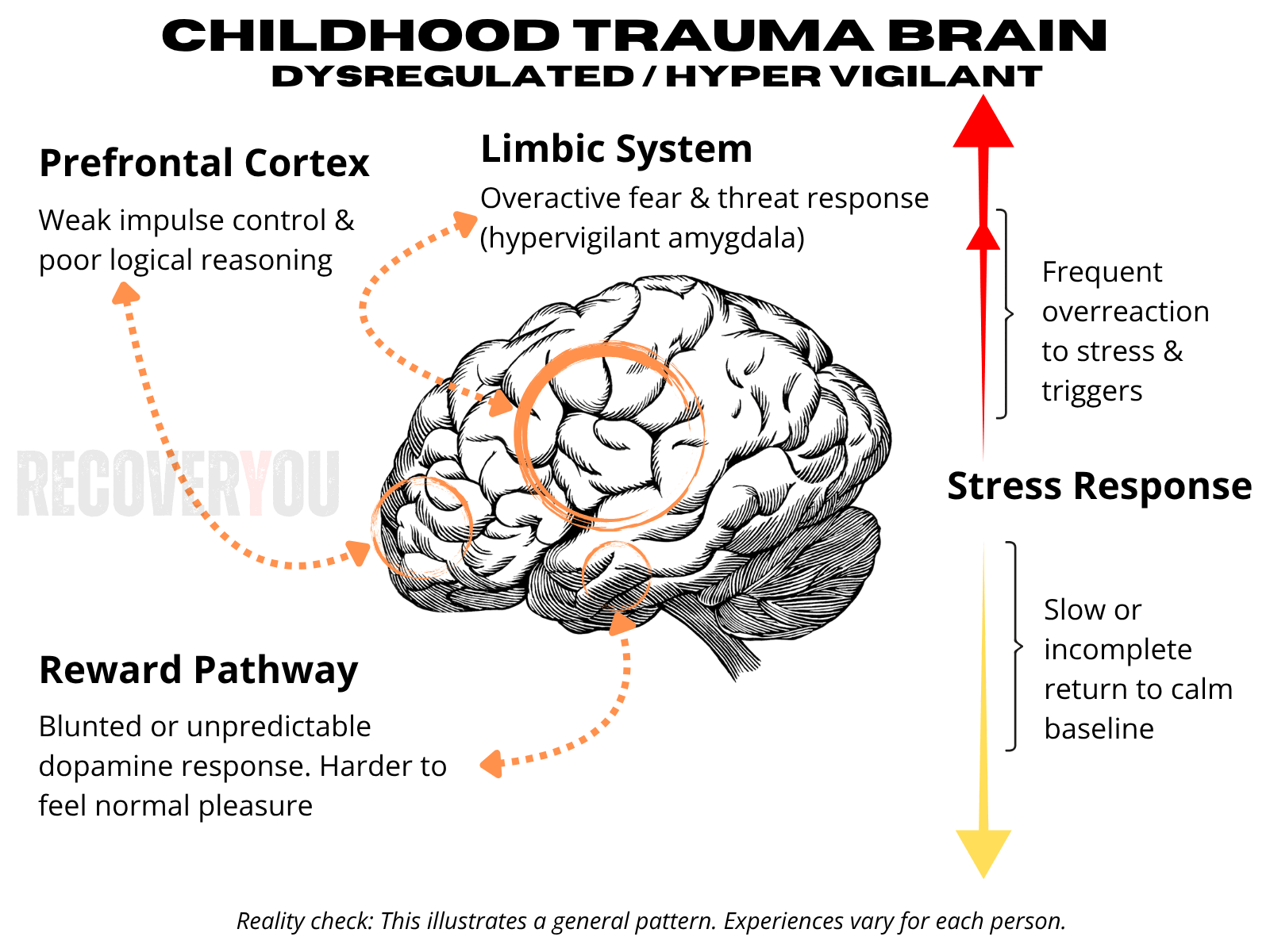
Childhood Trauma
(PTSD & CPTSD) Brain.An alarm system stuck on. Safety never fully registers.
- Amygdala scans constantly, even in safe moments
- Stress response floods the body with cortisol
- Prefrontal development disrupted, regulation is harder
- Dopamine reward blunted, joy and motivation feel distant
- Trust and safety struggle to take root
-

When Trauma and Addiction Collide.
Two forces compounding each other. The alarm never powers down, and the only available relief is the substance.
- Amygdala never powers down
- Stress response runs hot, fueling dysregulation
- Reward pathways lock onto compulsive relief, not true pleasure
- Prefrontal cortex struggles to regulate impulses
- Homeostasis breaks, sobriety alone cannot restore balance
Without addressing trauma, expecting the brain to reset through sobriety alone is unrealistic. Childhood wounds don't simply course-correct in standard treatment. They require direct healing for true balance to return.
// The Wall I Kept Hitting: What Traditional Treatment Missed
Every program I went through could stabilize me. None of them reached what was driving the addiction. I was told to work the program while quietly doing the real work elsewhere. Trauma therapy in one office, nervous-system regulation in another, attachment repair wherever I could find someone willing to go there.
The deeper I went, the more I realized these weren't alternative theories or fringe ideas. They were the foundations that had been missing all along. The ones that finally made healing feel possible instead of performative. And I had to find every single one of them myself.
The graphic below shows that gap clearly. What the standard, symptom-focused model provides, and what disappears when trauma isn't treated as part of the root system.

Where the Model Breaks
-
Even when you're ready, where the hell do you go?
In every treatment centre I've been in, the overwhelming majority of people had significant trauma in their history. That wasn't a clinical observation. It was just obvious from the conversations. But even if every one of them decided today to finally address that trauma directly, the system couldn't absorb it. There isn't enough qualified support to go around. Not even close.
Within Alberta Health Services, and now Recovery Alberta, trauma-specific therapy is severely under-resourced. Waitlists run months, sometimes over a year. Specialized providers are scarce. And if your trauma doesn't fit a narrow diagnostic profile, or doesn't look severe enough on paper, you can fall through entirely. People do. Regularly.
The honest answer: trauma-specific care does exist in Alberta. It just lives almost entirely in private practice. Therapists trained in ART, EMDR, IFS, somatic work. They're out there. The gap isn't knowledge. It's access. A single session can run $175 to $250. Employer benefits cover it, if you have them. Most people sitting in a residential treatment centre don't. They're not in treatment because life was going well. They've often lost jobs, housing, relationships. The people who need this care the most are the ones the private system was never built to reach.
In addiction, a waitlist isn't an inconvenience. It can be a death sentence. That's not hyperbole. That's what I watched happen.
Through private conversations with clinicians over the years, I've learned that many working inside the system see these gaps clearly and are just as frustrated. They're doing what they can inside a structure that isn't keeping pace with the science, the need, or the people in front of them.
The question isn't whether people want help. It's whether the system is equipped to give it when they finally ask. Too often, it isn't. And what gets offered instead, care that doesn't match the actual problem, isn't recovery. It's a holding pattern with a better name.
-
Diagnosis-Driven. Not Causality-Driven.
The DSM-5 gives clinicians a shared language, and that matters. But it also pulls the focus toward whether a symptom exists rather than why it does. I was treated for anxiety, depression, and substance use for years without anyone looking underneath them at the nervous-system dysregulation driving everything. It felt like treating a fever without ever asking what was causing the infection. The fever came down. The infection stayed.
-
Funding Structures That Fragment Care
The Canadian system reinforced separation at every level. Addiction in one lane. Trauma in another. Mental illness somewhere else entirely. Even when a clinician recognized the connections, funding rules, referral criteria, and eligibility requirements often forced them to treat each issue in isolation. What was one interconnected problem got divided into disconnected parts, managed by people who weren't allowed to talk to each other.
-
Trauma Isn't Always Obvious. It's Rarely Asked About.
Emotional neglect. Chronic unpredictability. Persistent invalidation. None of it felt like "trauma" to me at the time, and many of the clinicians I saw weren't trained to recognize it either. It wasn't until I started trauma-specific work that the full picture came into focus. Naming it was the first thing that made the addiction, the anxiety, and the shame-driven behaviour stop feeling inexplicable. They weren't random. They were responses.
-
Siloed Treatment. Disconnected Stories.
One program for addiction. Another for anxiety. Another for depression. Rarely did anyone step back and ask: what's the bigger story here? The DSM acknowledges comorbidity with PTSD, but in practice that link often went unexplored. Nobody was looking for the thread that connected everything. Without the narrative, treatment became patchwork. And patchwork doesn't hold.
-
The Medical Model Doesn't Do Narrative
It excels at naming what's wrong. It rarely asks what happened to you. No one ever asked me: what did you have to believe to survive? How did your nervous system adapt in ways that once protected you but now work against you? Trauma work asked those questions. It reframed behaviour as communication rather than pathology. That reframe was the beginning of something that actually held.
-
The System Is Changing. Slowly.
The ACE Study confirmed what survivors had already lived: childhood adversity reshapes the brain and drives significant long-term risk for addiction and mental illness. Trauma-informed approaches are gaining ground. Integrated models are beginning to appear. And people who once suffered silently are building the resources they couldn't find. Which is exactly why this site exists. The gap is real. So is the momentum closing it.
-
A Critical Distinction:
Trauma-Informed Care ≠ Trauma Treatment
Many facilities advertise "trauma-informed care." What that actually means is that staff have been trained to recognize trauma and avoid retraumatizing people. It does not guarantee they are equipped, or permitted, to treat it.
Trauma-informed is an orientation. Trauma treatment is a clinical intervention. They are not the same thing, and the difference matters enormously.
Actual trauma treatment requires trained clinicians using evidence-based approaches. EMDR, ART, somatic therapies. The work processes overwhelming experiences, regulates the nervous system, and rebuilds a person's internal narrative. A program that is merely aware of trauma is not doing that work.
The danger is when the label becomes a substitute for the work. When systems adopt trauma-informed language and stop there, as if acknowledgment alone heals anything. It doesn't. Awareness creates a safer space to hold pain. It does not resolve it.
If you or someone you care about is exploring treatment, ask directly: do they offer trauma-specific therapy, not just trauma-informed care? If not, can they connect you to external trauma services, or allow you to bring in your own clinician? Those are the right questions. The answers will tell you everything.
The System Treats the Symptom.
Recovery Requires the Root.
Addiction is rarely just about the substance. It's about pain, protection, and patterns that run deeper than willpower can reach. For trauma survivors, lasting freedom doesn't come from removing the escape. It comes from healing whatever made escape feel necessary in the first place.
I had to learn to heal the wound before I could put down the anesthetic. For good.
Where to Next?
Follow the next step in order, or branch out into related topics.
- Najavits, L. M. (2002). Seeking Safety: A Treatment Manual for PTSD and Substance Abuse. Guilford Press. Developed specifically because standard SUD treatment was failing trauma survivors — addressing the substance but not the co-occurring PTSD. Documents that PTSD and SUD are mutually reinforcing and that treating addiction without trauma leaves a significant vulnerability to relapse. Directly substantiates this page's central structural argument: standard treatment's limitation is not a failure of effort but of design. View on Goodreads
- Khantzian, E. J. (1997). The self-medication hypothesis of substance use disorders: a reconsideration and recent applications. Harvard Review of Psychiatry, 4(5), 231–244. Argues that substance use is motivated primarily by the need to relieve painful affect rooted in trauma rather than to achieve euphoria — and that specific substances are selected for their pharmacological effects on specific emotional states. Removing the substance without addressing the underlying affect creates the crisis described on this page: sobriety as exposure, not resolution. View on PubMed
- Mahon, D. (2025). A systematic review of trauma informed care in substance use settings. Community Mental Health Journal, 61(4), 734–753. Systematic review documenting the current state of trauma-informed care implementation in addiction treatment — confirming both the evidence for its effectiveness and the systemic gaps in its adoption, providing contemporary clinical context for this page's argument. View at Springer
- SAMHSA. (2014). Trauma-Informed Care in Behavioral Health Services. Treatment Improvement Protocol (TIP) 57. U.S. Department of Health & Human Services. Federal clinical guidance for integrating trauma-informed approaches into behavioral health and SUD treatment settings — formally acknowledging the gap between trauma's known role in addiction and the treatment infrastructure built to address it. Download PDF
- Felitti, V. J., Anda, R. F., et al. (1998). Relationship of childhood abuse and household dysfunction to many of the leading causes of death in adults. American Journal of Preventive Medicine, 14(4), 245–258. The original ACE Study — the decades of research that make the connection between trauma and addiction impossible to ignore, and that expose the inadequacy of treatment models that address only the substance. View via DOI
- Maté, G. (2008). In the Realm of Hungry Ghosts: Close Encounters with Addiction. Knopf Canada. Ground-level clinical and human argument that addiction is most accurately understood as a response to the unbearable pain of early adversity — making the structural case that any treatment approach ignoring this root cause is addressing only the symptom. View on Dr. Maté's Site
- Porges, S. W. (2011). The Polyvagal Theory: Neurophysiological Foundations of Emotions, Attachment, Communication, and Self-Regulation. Norton. Explains the neurophysiological reality that makes purely behavioural treatment inadequate for trauma survivors — that the autonomic nervous system must be addressed directly, and that no amount of cognitive restructuring will produce safety in a body still braced for threat. View on Goodreads
- Briere, J., & Scott, C. (2019). Principles of Trauma Therapy: A Guide to Symptoms, Evaluation, and Treatment (3rd ed.). SAGE Publications. Differential diagnosis and trauma-informed treatment planning framework — documenting the clinical complexity of co-occurring trauma and SUD and why standard protocols require structural modification to serve this population. View on Goodreads
- Hopper, E. K., Bassuk, E. L., & Olivet, J. (2010). Shelter from the storm: trauma-informed care in homelessness services settings. Open Health Services and Policy Journal, 3, 80–100. Documents the implementation of trauma-informed approaches in service settings and the structural barriers that prevent standard systems from delivering them — contextualizing this page's argument that the gap between knowledge and practice is systemic, not incidental. View on Research Gate
- National Institute on Drug Abuse. (2020). Drugs, Brains, and Behavior: The Science of Addiction. NIH. Authoritative overview of the neurobiological basis of addiction — establishing why abstinence alone does not restore normal regulation and why the brain changes produced by chronic substance use require more than willpower and behavioral accountability to reverse. Access NIDA Publication
These references explore the systemic limitations of traditional treatment, the neurobiology of trauma and addiction, and the evidence supporting integrated, trauma-informed care approaches. Educational only — not clinical advice.