In 1938, Harvard University launched a study that is still running today. For more than 85 years, researchers have followed hundreds of participants — and later their children — tracking health, relationships, careers, and life satisfaction across entire lifespans. The Harvard Study of Adult Development remains one of the most comprehensive investigations into what actually makes a life fulfilling — not what we assume makes it fulfilling, but what the data, accumulated across decades, consistently points toward.
The finding is simple enough to dismiss — which is exactly why most people do:
"The quality of your relationships is the strongest predictor of your health and happiness."
Not wealth. Not status. Not diet or fitness or any other variable the self-improvement industry has monetized.
Early recovery comes with a phrase that gets repeated so often it starts to sound like doctrine: "Recovery is selfish." The logic: protect your sobriety, guard your energy, keep your distance from anyone who might pull you off course.
"Recovery is selfish." But is it — really?
Selfishness, by definition, is self-centered behavior with little or no regard for others. Recovery is something fundamentally different: it's self-compassion. For people shaped by trauma and addiction, self-compassion often feels foreign — even suspect. When we finally set a boundary or prioritize our own healing, it's easy for others — or for ourselves — to reach for the selfishness label, simply because the language of self-care was never modeled for us. We mistake the unfamiliar for the wrong.
And the evidence contradicts the framing entirely. Nearly everyone I met in treatment was there not just for themselves — but for someone they loved. A parent. A child. A partner they were afraid of losing. Beneath every recovery story was the same quiet hope: not just to stop, but to repair what had broken and rebuild what mattered. That isn't selfishness. That's one of the more profound acts of love available to a person — one that starts internally and moves outward.
There is a grain of truth in the phrase, though. Early sobriety does require a period of genuine self-focus — time to stabilize, to rest, to establish enough ground to stand on before reaching toward anyone else. The danger is treating that period as the destination. Recovery that never expands beyond self-preservation produces people who are sober but sealed off — functional, guarded, and quietly starving for the one thing the Harvard data says matters most.
The study's conclusion isn't just an observation about happiness — it's a clinical argument for why isolation is incompatible with genuine recovery. Even programs like AA, for all their limitations, understood this intuitively long before the research confirmed it: sponsorship, meetings, and service work all create conditions for being seen, known, and needed. Connection isn't a reward for getting well. It's part of the mechanism by which getting well becomes possible — a protective force for mental health, resilience, and physical longevity that no amount of solo work can replicate.
I've lived both sides of this — and I've watched both sides fail. In one round of treatment, my need to connect had me overextending toward everyone around me, reaching out, absorbing other people's chaos, using the relationships to avoid the deeper work I was actually there to do. The connections felt real. The avoidance was real too.
The next time, I overcorrected. Shut the door. Kept my head down. Studied, worked the material, stayed focused. By the clinical measures, I was doing everything right. What I didn't realize was that I was also practicing isolation — getting very good at not needing anyone, which is its own kind of problem when the thing you're recovering from was partly built on exactly that skill.
Connection is a muscle. Disuse doesn't just weaken it — it makes the act of reaching out feel increasingly foreign, until the moments when you most need to do it are precisely the moments it feels most impossible. That pattern shows up constantly in recovery: the person who did the solo work, got sober, stayed sober, and is now so practiced at self-containment that genuine intimacy feels like a threat. Functional. Isolated. And not entirely sure why the sobriety still feels hollow.
The push and pull between solitude and belonging isn't a problem to solve — it's a tension to navigate. Solitude has real value in recovery: it's where the honest inventory happens, where the noise quiets enough to hear what's underneath. But solitude without the counterweight of connection has a ceiling — and it's much lower than most people expect. At some point, the healing that's available alone runs out, and the rest requires another person. That's not a weakness in the model. That's the model.
The work is learning when to turn inward — and when to risk reaching out.
For many of us, isolation wasn't just a symptom of addiction — it was its soil. Disconnection felt safe, predictable, familiar. It asked nothing of us and threatened nothing we hadn't already lost. Reaching toward people can feel like walking into a fire, even when some part of us knows — has always known — that it's the only thing that will actually help.
The problem is that trauma teaches us to read connection as danger. Early relationships that were supposed to be safe became sources of harm, and the nervous system took careful notes. By the time we're adults, the instinct to withdraw isn't stubbornness or antisocial behavior — it's a protection strategy that once worked and never got updated. Asking someone shaped by that history to simply "open up" or "let people in" is a bit like asking someone with a broken leg to walk it off. The willingness might be there. The wiring isn't.
Which is why connection in recovery has to be approached the same way everything else in recovery is approached: deliberately, incrementally, and with the understanding that discomfort is not the same as danger. Not a leap of faith but a series of small tests — each one building the evidence base that the nervous system needs before it will consent to update its threat assessment. Trust isn't a decision. It's accumulated proof.
The science confirms what the lived experience already knows: relationships heal the body. But they also do something the biology can't fully account for — they heal the story we tell about ourselves. Every time someone stays when you expected them to leave, shows up when you assumed they wouldn't, or simply sits with you in something hard without trying to fix it or flee from it — the story shifts slightly. Not dramatically. Not all at once. But enough. And enough, repeated, is how the rewrite actually happens.
Connection isn't just medicine — it's proof that you were never meant to heal alone.

There's a phrase that circulates in recovery spaces: "The opposite of addiction is connection." It lands because most of us know exactly what it describes — the specific hollowness of being cut off from others, from ourselves, from anything that felt like it mattered. Addiction fills that void, badly, and at enormous cost. Connection offers something real in its place. The phrase sticks because it points at something true: recovery requires rebuilding relationships.
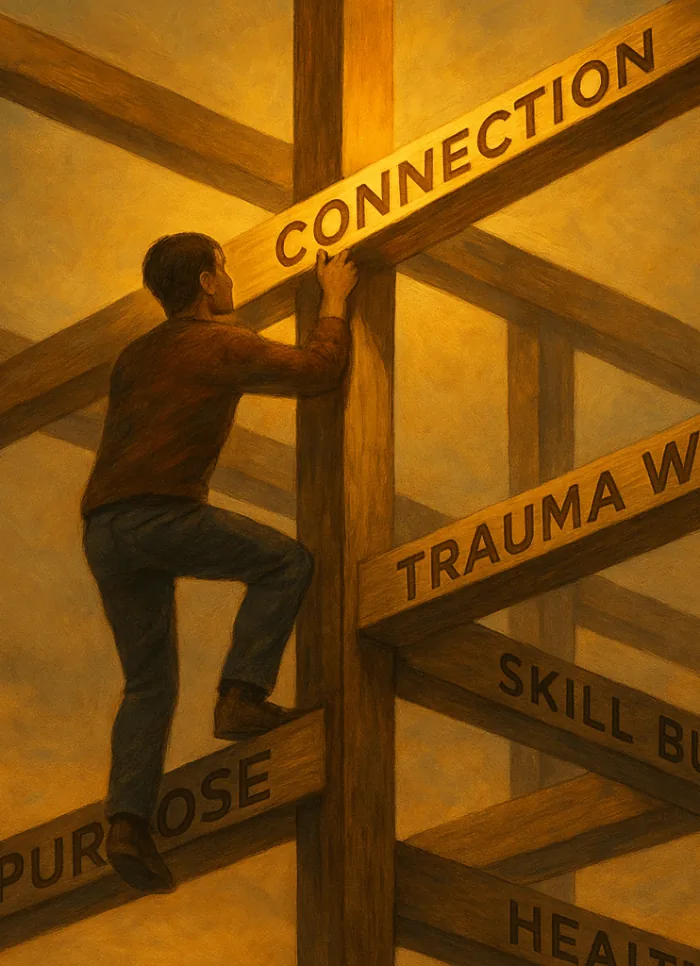
But the slogan is incomplete. If connection alone were sufficient, everyone who found community would stay sober — and we know that isn't what happens. Connection is a load-bearing pillar. It is not the whole structure. Recovery that lasts is built on multiple supports, each reinforcing the others.
For some people, community alone provides a strong enough container. AA and peer support have kept people sober for decades and that's not nothing — that's everything, for those people. But for many — particularly those carrying trauma or co-occurring mental health conditions — connection without the deeper work is scaffolding around an unrepaired foundation. It holds things up for a while. It is not the same as building something that lasts.
• The most isolated participants weren't just unhappier — they got sicker faster and died younger. The body keeps the score on loneliness the same way it keeps score on anything else that chronically threatens it.
• This isn't about being introverted or preferring your own company. It's about whether you have relationships where you feel genuinely seen, safe, and known. That distinction matters.
• People with close relationships recovered from stress more quickly — not just emotionally, but measurably, in their cortisol levels and physiological return to baseline. Connection is a biological regulator, not just an emotional one.
• In recovery, this means a solid relationship isn't just support — it's a buffer against the moments that would otherwise send you back. Cravings, grief, instability. Having someone in your corner changes what your nervous system does with all of it.
• Some participants had large social networks and still felt profoundly alone. Others had one or two relationships and thrived. The study is unambiguous: depth beats breadth. Being known by a few people matters more than being liked by many.
• For those of us in recovery who aren't naturally social, or who burned most of our bridges getting here — this is the finding that matters most. You don't need a community. You need one or two people who actually show up. Start there.
• Strong social ties were linked to sharper memory and significantly slower cognitive decline in later life. The brain, it turns out, needs relationship the same way it needs sleep — not as a luxury, but as maintenance.
• For anyone rebuilding after addiction, this lands differently. The brain is already doing repair work. Connection accelerates that process. It isn't just emotional medicine — it's neurological. And it's available to you right now.
Dr. Robert Waldinger – The Harvard Study of Adult Development
Watch on YouTube
Psychiatrist Robert Waldinger shares insights from the 85-year-long Harvard Study of Adult Development — one of the most comprehensive looks at what truly makes life fulfilling.
Robert Waldinger has spent decades as the steward of the longest study ever conducted on human happiness. His conclusion isn't complicated — but it runs directly counter to almost everything the self-improvement industry has been selling: the quality of your relationships predicts your health, your longevity, and how much your life actually feels worth living. Not your discipline. Not your net worth. Your relationships.
For those of us in recovery, that finding isn't abstract. Most of us know, from the inside, what disconnection costs. We lived the hollowness of it. We used substances to fill the space where belonging was supposed to be. What Waldinger's data adds is the confirmation that this wasn't just a feeling — isolation is physiologically harmful, measurably so, in ways that compound over time and show up in the body.
The research also reframes what recovery is actually for. It's not just about removing the substance. It's about rebuilding the conditions that make a life sustainable — and connection is near the top of that list. Not as a reward for getting well. As part of the mechanism by which getting well becomes possible.
If addiction is a disease of disconnection, then recovery is the long, deliberate work of reconnection — with yourself first, then with others, then with a version of life that finally feels worth inhabiting. The Harvard data doesn't just suggest this — it quantifies it across 85 years and hundreds of lives: the quality of your relationships is one of the strongest predictors of health and wellbeing ever measured. Not a variable. A cornerstone.
But connection alone doesn't finish the job. It is one load-bearing wall in a structure that needs several — and the walls only hold when they're built on something solid underneath. Trauma work. Skill-building. Purpose. Physical health. Connection without those is scaffolding around an unrepaired foundation. It can hold things up for a while. It is not the same as building something that lasts.
Reconnection doesn't mean returning to who you were or resurrecting the relationships that were part of the damage. It means building something new — starting with yourself, which is where every other relationship either finds its footing or quietly falls apart. The people worth choosing are the ones who support who you're becoming. Not who you were when the void was loudest.
Recovery isn't about going back to who you were.
It's about understanding why you became who you did — and then, with that clarity, choosing something better on purpose.
Follow the next step in order, or branch out into related topics.
These sources reflect converging evidence across longitudinal research, neuroscience, and trauma-informed care: strong, safe relationships are among the most powerful predictors of mental health, physical health, and long-term recovery outcomes. Connection is not simply emotional support — it is a biological regulator, a protective factor against relapse, and a core mechanism through which healing becomes possible.