The Critical Window

When “just get over it” never works — and science explains why.
15 min read
// The First Blueprint:
How Experience Becomes Biology

From conception through roughly age seven, the human brain is in the most dynamic period of development it will ever experience. By around age seven it has reached approximately 90 to 95 percent of its adult volume — which sounds like the hard work is mostly done. It isn't. Size is the least interesting part of the story. What's actually happening is the wiring — the formation and pruning of neural circuits that will determine, for the rest of that person's life, how efficiently they process emotion, regulate stress, and connect with other human beings.

This is not about blame. It's about biology. The environment a child develops in — emotionally, socially, physically — becomes the first architect of the nervous system, operating under a single directive written into its design from the beginning: adapt for survival. Not for flourishing. Not for happiness. For survival — whatever the current environment requires that to mean.

Every moment of nurture or neglect is being transcribed into the developing system — not as memory, not as narrative, but as structural wiring that will run silently beneath conscious awareness for decades. This is the blueprint. And most people never get to see it.

Seeing the blueprint doesn't mean you're locked into it. It means you finally have something you can work with.

// The Brain's Construction Phase:
Birth to Age Seven

Picture the most ambitious construction project in the known universe — scaffolding rising, wiring going in at a pace that would make any contractor weep with envy, and zero lunch breaks.

  • At birth, the brain is approximately 25% of its adult size — which is remarkable considering it already runs the entire operation.
  • By age three it has surged to 80%, and by age five to 90%.
  • During this window, the brain forms over one million new synaptic connections per second — a rate it will never come close to again.

These connections aren't random. They're activity-dependent — built and reinforced by experience, pruned away by the absence of it. Every interaction — a smile, a soothing voice, a touch that says you are safe and you matter — activates specific circuits and signals the brain to invest in them. Every absence of those signals sends a different message entirely. In this sense, experience isn't just something that happens to a child. It is nutritional input for the developing brain — and like nutrition, both the presence and the quality of it determine what gets built.

// The Miracle Machine:
The Brain in Early Development

Full nerd disclosure: the brain is one of the most genuinely astonishing things I have ever spent time reading about — and I say that as someone who has spent a considerable amount of time reading about things that were trying to kill me. Three pounds. Slightly wrinkled. Runs on glucose, electricity, and chemistry. Contains approximately 86 billion neurons — billion with a B — each one capable of forming thousands of individual connections, all shaped by experiences so specific to you that no two brains on the planet are wired identically. These cells communicate through electrochemical signals traveling at up to ~250 mph, producing thought, movement, emotion, and memory in simultaneous coordination. You think fingerprints are rare? I would argue brains are, by several orders of magnitude.

Think of it like a computer — except this one is biological, self-programming, and doing the programming while simultaneously running every other process that keeps you alive. The core architecture arrives pre-built, but the operating system gets written in real time as the brain encounters the world — constantly updating, installing new software, patching vulnerabilities, all in service of one primary goal: keeping you alive.

What makes early development specifically remarkable isn't just the brain's complexity — it's its radical adaptability. In early childhood, the brain exists in a state of open possibility — a vast network of roads being built simultaneously, where every experience determines which routes get paved into highways and which get quietly abandoned. This is neuroplasticity at its most extreme — and it never operates at this intensity again.

Most people assume children learn faster simply because they're newer to everything — empty containers absorbing skills through repetition. The truth is considerably more interesting. A child's brain isn't just less experienced — it's more fluid, more malleable, and genuinely less constrained by pre-existing patterns because most of those patterns haven't been laid yet. The main roads aren't paved. Which means creativity, flexibility, and imagination can move freely across the whole landscape. It's not innocence alone that makes childhood remarkable. It's the architecture.
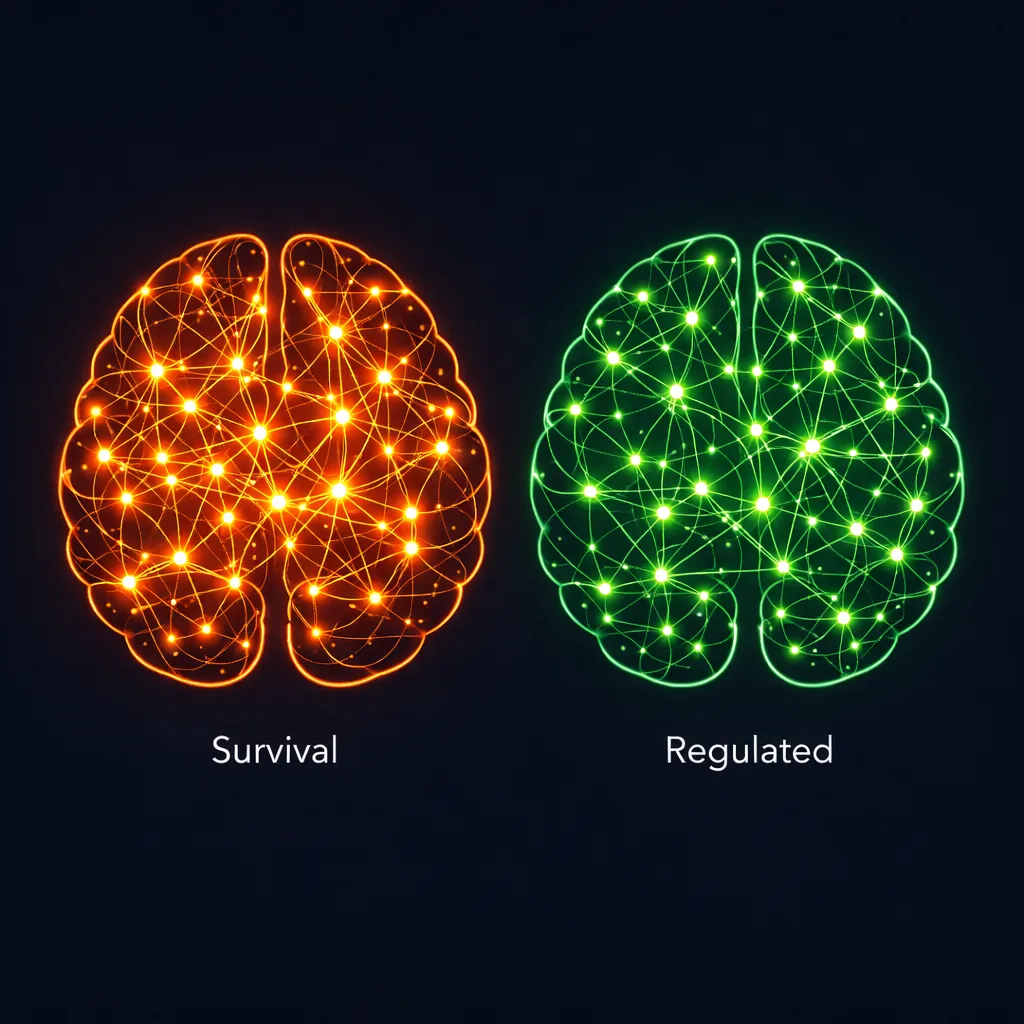
Survival vs Regulated brain pathways

Different wiring for different environments.
Neither is wrong. Both are adaptive.

But that same openness cuts both ways. When early experiences are nurturing — consistent care, attunement, safety, repair after rupture — the brain wires for curiosity, connection, and confidence. When those experiences are chaotic, frightening, or absent, the brain wires for survival. Not because anything went wrong with the brain. Because the brain did exactly what it was designed to do — adapted instantly to the environment it was given, without waiting for permission or better options. And without intentional repair later in life, that survival wiring persists — quietly shaping perception and behavior long after the original conditions are gone.

The very quality that makes the brain miraculous — its capacity to adapt to almost anything — is precisely what makes early adversity so difficult to undo. The brain wasn't broken by what happened. It was built by it. And built things require deliberate work to rebuild.
// Serve and Return:
The Dance that Builds the Mind

Development isn't automatic. It's relational. It happens in the space between one person and another — specifically, between a baby and whoever shows up for them.

  • When a baby babbles, reaches, smiles, or cries — that's a serve.
  • When a caregiver responds with eye contact, words, touch, or soothing — that's a return.

These exchanges — thousands of them, daily, across years — form the brain's first working model of how the world operates. They build the neural architecture that supports emotional regulation, stress tolerance, attention, language, and the capacity to trust another person. Part of what is being shaped here is the right orbitofrontal cortex — a region heavily involved in reading emotional cues, making sense of internal states, and learning how to regulate in relationship. In other words, serve and return is how a child learns that people are safe and that they themselves matter. No classroom required. Just someone who keeps showing up.

When those returns are absent, inconsistent, hostile, or frightening, the brain reorganizes its priorities without asking permission. Instead of wiring for curiosity and connection, it wires for survival. The nervous system concludes, from available evidence, that the world is unpredictable, that comfort is unreliable, and that constant vigilance is the only rational response. This is the root of insecure attachment — not a character flaw, not a personality defect, but a completely logical developmental adaptation to an environment that couldn't reliably provide safety.

Critical Window The brain does not treat all periods of development equally. Research into neuroplasticity points to a particularly sensitive window — roughly ten to eighteen months — where the relational circuitry shaped by serve and return is most vulnerable to disruption. The patterns laid down here don't just influence early childhood. They become the load-bearing architecture everything else is built on top of. Miss the window, and you're not just missing warmth — you're missing the foundational wiring for how safety, connection, and self-worth get encoded.

And here is the part most people never consider: the effects do not stay in childhood. These early relational rhythms — or their absence — become the unconscious templates carried into adulthood. They shape how we seek closeness, how we handle conflict, how we interpret ambiguous signals from other people, and how we try to soothe ourselves when the nervous system decides the emergency is back on. The dance that built the mind becomes the dance we keep performing — until someone finally teaches us a different one.

// Survival Mode:
When Old Programs Keep Running

After childhood trauma, the brain reorganizes around one overriding priority: avoid threat. The problem is that this survival wiring has no interest in your conscious goals. It doesn't care about your sobriety, your relationships, or the life you're trying to build. It cares about one thing — getting you away from pain as fast as possible, by whatever route it already knows works.

So it keeps running the old scripts. The ones that once brought relief — even when that relief came packaged as self-destruction. These patterns don't update automatically with time, insight, or good intentions. They persist until something deliberately interrupts them. The brain isn't being stubborn. It's being efficient — executing the fastest available path to relief based on decades of confirmed results.

This is why the cognitive work in recovery is non-negotiable. The brain will actively resist updating its old patterns because within those patterns lies the route it knows — the familiar thought loops that function as open doorways back to whatever once numbed the pain. Closing those doors requires more than willpower. It requires building new routes compelling enough to compete with the ones that have been reinforced for years.

This is why recovery feels brutal. You are refusing what your own brain has classified as safety — rewriting survival contracts that were written before you had any say in the terms. You are teaching a system calibrated for emergency that safety can exist without escape. That stillness is not the same as surrender. That staying is not the same as being trapped. In the gap between craving and choice — that narrow, exhausting, often invisible space — is where the actual work happens. And where real change becomes possible.

// Shame Buster
It's less a moral battle than a biological one.

If you've ever asked yourself "Why can't I stop thinking this way?" — your brain is not working against you. It is working to protect you, using the only tools it was ever given, executing a threat-reduction protocol that was built long before you had any say in the design. That's not weakness. That's adaptation doing exactly what it was built to do.

This is also why a brain can keep you stuck in patterns that are quietly destroying everything you're trying to build. Its goal isn't sabotage — it's protection, applied to the wrong target. Over time, the brain can confuse relief with safety and keep steering you back toward what hurts, genuinely convinced it's doing its job. That confusion — between what feels safe and what actually is — is what makes recovery so difficult. And what makes continuing anyway so significant.

  • Name the loop: "This is my threat-and-relief script running — not reality."
  • Label the need: "My brain is asking for safety. Not a substance. Safety."
  • Choose one tiny opposite action: 60 to 90 seconds of paced breathing, cold water on your face or hands, or a single text to a safe person. The action doesn't have to be large. It has to be different.

Recovery means interrupting the loop — not punishing yourself for having one. Every time you resist an old pattern, you are not white-knuckling your way through willpower. You are giving your brain the evidence it needs to build a new pathway. One refusal at a time.

// Critical Windows:
Timing Is Everything

The brain develops on a biological timetable — a sequence of critical and sensitive periods when specific systems must be built, reinforced, or calibrated. These windows function like construction phases: miss them, and what gets built in their place is always a workaround.

  • Critical periods are narrow, non-negotiable windows when the brain is uniquely primed to form specific capacities — secure attachment, visual processing, early language structures. If the right input is absent during this window, full function may be permanently limited — or require significant compensatory work to approximate later.
  • Sensitive periods are longer spans of high plasticity — the years when emotional regulation, language fluency, and social learning develop most naturally. These capacities can still be built after the window closes, but with considerably more effort and rarely with the same ease.

When the right input is missing, the brain doesn't stop — it adapts. It builds alternative routes to manage what it can't process directly. Those routes work. They carry hidden costs. And those costs travel forward into adulthood without a label that explains where they came from.

  • A child who learns that soothing is unreliable develops hypervigilance in its place — because constant alertness is more reliable than hope.
  • A child who learns that love is conditional wires performance-based worth into their identity — because earning approval is more survivable than risking rejection.

These aren't character flaws. They're engineering solutions — brilliant, costly, and poorly suited to the adult life they eventually have to navigate. Understanding the timing of these windows explains why early support is so powerful — and why later healing, while always possible, is work rather than recovery. You aren't returning to something. You're building something that was never there to begin with.

// When the Blueprint Warps:
Trauma and the Developing Brain

When safety is replaced with chaos, neglect, or chronic fear, the body's stress system — the HPA axis — stays switched on. Cortisol and adrenaline, designed for short controlled bursts, become the default operating conditions. The system was never built to run at that level continuously. It runs anyway.

This chronic stress lands on a brain that is not just highly active — it's extraordinarily fragile. The systems being built right now — attachment, emotional regulation, threat detection, learning — are under construction. They are not yet complete. They are receiving live inputs and building around them in real time. If you had to identify the single worst moment to subject a developing brain to prolonged relational trauma, it would be exactly this window — while the blueprint is still being drawn.

Chronic stress chemistry disrupts that construction in three areas that will shape everything else:

  • Prefrontal cortex — weakened executive function, impulse control, and the capacity to pause before reacting
  • Amygdala — heightened threat sensitivity, a hair-trigger alarm system that fires early and often
  • Hippocampus — disrupted memory consolidation, learning, and the ability to place emotions in accurate context

The result isn't "bad behavior." It's a nervous system that was calibrated, correctly, for a dangerous world. A child who lives in constant threat learns to scan continuously, mistrust calm, and treat safety as a setup. What looks like defiance, self-sabotage, or addiction years later is often this early blueprint still executing faithfully — doing exactly what it was trained to do in conditions that no longer exist.

This isn't a counsel of hopelessness. It's an honest account of cause and effect. When early environments are unstable, the impact is deep, structural, and long-lasting — which makes your current struggles predictable, not personal. The same brain that adapted to survive chaos can be guided, over time and with the right conditions, to adapt toward safety. It is slower going than we'd like. It is not the same as impossible.

// From Development to Destiny:
The Long Shadow of Early Stress

The ACE (Adverse Childhood Experiences) research confirmed what neurobiology had been building toward for decades: early adversity doesn't stay in the past. It leaves structural fingerprints — in the immune system, the endocrine system, the nervous system — that persist long after the original conditions are gone.

  • Increased risk of heart disease, diabetes, and autoimmune illness
  • Higher rates of anxiety, depression, PTSD, ADHD, and addiction
  • Shortened lifespan from the accumulated biological wear of chronic stress (allostatic load)

Trauma is not just remembered — it is embodied. It lives in the body's systems, not just in memory, running quietly beneath conscious awareness long after the danger has passed.

I can say this with unsettling personal clarity: these patterns didn't arrive for me through academic papers or graphs. They arrived as my life. My own inventory of diagnoses, symptoms, and health issues reads almost like a direct transcription from the outcomes identified in the original ACE Study — anxiety, PTSD features, attention dysregulation, chronic stress responses, addiction. All of it present. All of it named, finally, only after I understood where it came from. Before that, it just looked like me being broken.

Seeing my lived experience reflected in the data wasn't a devastating moment. It was clarifying. It meant the problem wasn't a defect in my character — it meant my early environment had shaped my biology in exactly the ways the research predicted. And if a brain can adapt that powerfully in one direction, it can — with the right conditions and deliberate effort — adapt in another. That's not optimism. That's the same mechanism, redirected.

// Rewriting the Blueprint:
What This Means for Recovery

The part most people resist accepting: the influence of early development doesn't stop at the border of childhood. It extends — quietly, structurally — into every decade that follows. Not because recovery is hopeless, but because the patterns built during critical and sensitive periods become the brain's default operating system. And default systems don't tend to update themselves just because circumstances improve. They typically keep running until something deliberately replaces them.

We prefer the story where growing up means growing out of the past — where maturity arrives on its own with wisdom, stability, and the quiet dissolution of everything that formed us under duress. Human development doesn't operate on fairy-tale logic. When early conditions are nurturing, the nervous system builds naturally toward connection, regulation, and resilience. When they aren't, it adapts for survival instead. And those survival adaptations do not spontaneously correct when the calendar says we're adults. They tend to persist.

Without new experiences and healthier models to build on, we don't evolve into better versions of ourselves. We repeat what we absorbed early — sometimes with variations, rarely in a meaningfully better direction. Adults don't override their wiring through good intentions. They live out the blueprint they were given until they do the deliberate work of rebuilding it.

This reframes what recovery actually is. Not a battle against weakness. Not a test of character. The process of finishing a development that was interrupted before it could complete. Learning the regulation skills, relational patterns, and emotional capacities the early environment never provided. You're not repairing a broken system. You're finally giving your brain the conditions it needed in the first place and never got.

Redrawing the blueprint of the mind

This is where neuroplasticity stops being a concept and becomes a lifeline. The same mechanism that once wired you for survival in a dangerous world can now be directed toward stability, connection, and growth. Not because time has passed. Not because you've finally decided to try hard enough. But because you are creating — deliberately, consistently — the conditions for healing that were never present before. That's not magic. That's the brain doing what it has always done: adapting to its environment. You're just finally in charge of what that environment is.

// Where to Go From Here

The blueprint was written under conditions you didn't choose.
The rewrite happens under conditions you do.

Understanding this doesn't make the work easier — but it changes what the work actually is. Not managing symptoms indefinitely. Not performing recovery. Building, for the first time, the conditions your nervous system needed from the beginning: safety, honest connection, and a self you can act from rather than hide. The pages below go deeper into each piece of that.

Where to Next?

Follow the next step in order, or branch out into related topics.

Sources + Further Reading
  1. Knickmeyer, R. C., et al. (2008). A structural MRI study of human brain development from birth to 2 years. Journal of Neuroscience, 28(47), 12176–12182. MRI study tracking brain development in 98 children from birth to age 2 — documenting that the brain nearly doubles in volume in the first year of life, with the most rapid structural changes in the first 24 months. Provides the neuroimaging basis for the developmental trajectory of 25% adult volume at birth, 80% by age 3, and 90% by age 5 cited on this page. View on PubMed
  2. National Scientific Council on the Developing Child. (2004). Young children develop in an environment of relationships. Working Paper 1. Harvard Center on the Developing Child. Synthesizes research on serve-and-return interactions — demonstrating that responsive caregiving literally activates and reinforces neural circuits associated with emotional regulation, language, and social cognition, while absence of those signals leaves those circuits under-developed. The relational basis of brain architecture in direct scientific terms. View Working Paper
  3. Center on the Developing Child at Harvard University. (n.d.). Key concepts: brain architecture, toxic stress, serve and return. The foundational public-facing resource hub for critical period research, relational development, and the stress biology of early childhood — synthesizing the science behind brain architecture and sensitive periods in accessible form. Access Harvard Resource
  4. Shonkoff, J. P., Garner, A. S., et al. (2012). The lifelong effects of early childhood adversity and toxic stress. Pediatrics, 129(1), e232–e246. Gold-standard overview — authored by the Harvard Center on the Developing Child — documenting how early adversity alters neural, endocrine, and immune systems in ways that persist across the lifespan, and distinguishing positive, tolerable, and toxic stress responses based on the presence or absence of a buffering caregiver relationship. View on PubMed
  5. Knudsen, E. I. (2004). Sensitive periods in the development of the brain and behavior. Journal of Cognitive Neuroscience, 16(8), 1412–1425. Core scientific work defining and distinguishing critical and sensitive periods — establishing that specific neural circuits are highly plastic for only a narrow developmental window, and that experiences during these windows have disproportionate and lasting effects on brain organization. View via DOI
  6. McEwen, B. S., & Stellar, E. (1993). Stress and the individual: mechanisms leading to disease. Archives of Internal Medicine, 153(18), 2093–2101. The original formulation of allostasis and allostatic load — establishing that the cumulative biological cost of chronic stress disrupts multiple body systems and drives disease, providing the physiological foundation for understanding how toxic stress in the critical window produces measurable long-term health consequences. View via DOI
  7. Felitti, V. J., Anda, R. F., et al. (1998). Relationship of childhood abuse and household dysfunction to many of the leading causes of death in adults. American Journal of Preventive Medicine, 14(4), 245–258. The original ACE Study — connecting early adversity to adult mental and physical health outcomes across more than 17,000 participants, establishing the dose–response relationship that gives the critical window framework its clinical urgency. View via DOI
  8. Bremner, J. D. (2006). Traumatic stress: effects on the brain. Dialogues in Clinical Neuroscience, 8(4), 445–461. Documents how chronic stress and trauma during development produce measurable structural changes in the prefrontal cortex, amygdala, and hippocampus — the three brain regions most directly implicated in the "blueprint warps" described on this page, and the neurological basis for why early adversity alters emotional regulation, threat detection, and memory across a lifetime. View on PubMed
  9. Van der Kolk, B. A. (2014). The Body Keeps the Score: Brain, Mind, and Body in the Healing of Trauma. Viking. Seminal synthesis of trauma's effects on the developing mind and body — describing how early adverse experience becomes encoded in somatic and neural systems, and why healing requires working with those systems directly rather than through cognitive approaches alone. View on Goodreads
  10. Burke Harris, N. (2018). The Deepest Well: Healing the Long-Term Effects of Childhood Adversity. Houghton Mifflin Harcourt. Brings ACEs, toxic stress, and the biology of the critical window into modern clinical medicine — translating the research on early adversity into a framework for understanding why adult health problems so often have childhood roots. View on Goodreads

These references reflect the core scientific foundations of early brain development, sensitive periods, toxic stress, and the long-term health impacts identified in the ACE Study. They support the educational content on this page and are not a substitute for medical or clinical advice.

Feeling overwhelmed by what you’ve read? Support is here • Call 988 Anywhere in Canada 24/7 Suicide Crisis Line • In Alberta call 211 (community & mental health referrals) • Distress Line 780-482-HELP • 911 in emergencies