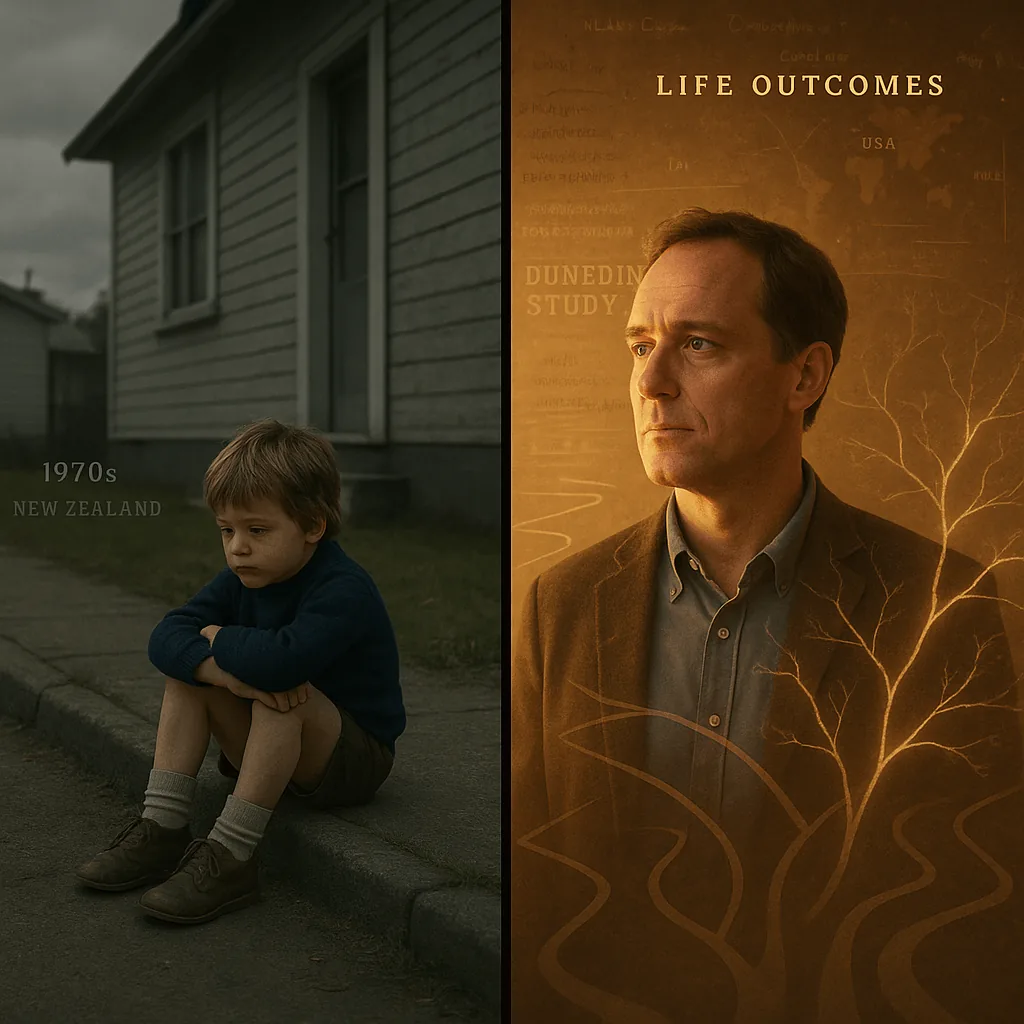
Understanding how trauma shapes a life is extraordinarily difficult. Most research has to work backward — looking at adults already in pain, tracing patterns in hindsight, trying to reconstruct what happened after the damage is visible and the window to intervene has long since closed. By the time the data exists, the moment that mattered most is years gone.
In a perfect world, you would begin at the beginning. Follow an entire group of children born at the same time, watch them grow across decades, and measure what actually unfolds — health, behaviour, psychology, biology, relationships, coping patterns. Not reconstructed. Not estimated. Observed.
On paper, that sounds impossible. Too expensive. Too complex. Too invasive. Too fragile to hold together across the decades it would take. The level of trust alone would seem out of reach.
In Dunedin, New Zealand, beginning with children born between April 1972 and March 1973, that impossible study was built. A cohort of 1,037 children enrolled and followed across a lifetime — with a continuity that remains genuinely rare in science.
That last point matters more than it might appear to. Long-term studies are quietly undermined when the most burdened participants disappear first — exactly the people whose outcomes matter most. The Dunedin Study became so influential in part because it largely solved that problem. Retention stayed above 90% among living study members across decades — a remarkable achievement, and a primary reason its findings carry the weight they do.
The result is not simply a respected study. It is one of the clearest windows science has ever produced into how early life actually shapes adult outcomes. Health. Addiction. Mental illness. Violence. Social functioning. Self-control. Stress reactivity. Aging. The Dunedin Study did not reduce people to a single diagnosis or a single data point. It followed whole human beings long enough to show how a life actually unfolds — and what gets set in motion long before anyone thinks to look.
One of the study's most sobering findings was that outcomes were not evenly distributed across the cohort. A relatively small segment accounted for a disproportionate share of social welfare use, hospital burden, prescription burden, injury claims, and criminal convictions. In other words: suffering clustered.
While the findings may be uncomfortable, they rightly identified something critical. The people who struggle most later in life are often not random outliers — many were showing signs of accumulating burden early. Not moral failure. Not laziness. Not weak character. Burden. Early, accumulating, and too often missed by every system that was supposed to catch it and instead just passed them along.
For anyone trying to understand trauma and addiction, this is difficult to look away from. The Dunedin Study makes visible a truth that mainstream recovery still struggles to say plainly: by the time addiction becomes obvious, the underlying developmental story has often been quietly unfolding for years — sometimes decades. The addiction wasn't the beginning. It was a late-stage signal. And we keep treating the signal like it's the whole story.
For a study this consequential — one that has traced how early life shapes decades of physical, psychological, and social outcomes — the fact that it remains largely unknown in mainstream recovery spaces isn't just a gap in awareness.
It's a failure we keep paying for.

The Dunedin Study dismantled something that much of mainstream recovery still hasn't fully absorbed: that adult outcomes are not primarily the product of willpower, isolated decisions, or moral character. They are shaped — often profoundly — by environments and experiences established long before the person had any say in them. The study didn't just suggest this. It demonstrated it, across decades, in real lives. And recovery culture has largely looked the other way.
That's not a counsel of determinism. It's the opposite. Understanding where a pattern came from is the first step toward not being permanently governed by it. Knowing the origin doesn't erase agency — it's what makes genuine agency possible in the first place. You cannot redirect a trajectory you don't know you're on. You cannot dismantle wiring you've been told doesn't exist.
The original cohort was drawn from one city in one era — a legitimate limitation worth naming. But replication studies across the United States, the United Kingdom, Israel, and elsewhere have returned the same findings with striking consistency. The mechanisms driving these outcomes are not primarily cultural or economic. The micro-dynamics of early life — family environment, self-regulation, the presence or absence of safety and attunement — appear to matter more than the macro-context surrounding them. Adversity looks different across societies. What it does to a developing nervous system appears remarkably consistent.
One city. One era. Universal results.
The Dunedin Study is the gold standard — but it isn't an outlier. Major longitudinal studies across the globe have returned the same findings with striking consistency. The culture of adversity changes. The geography changes. The era changes. What early stress does to a developing nervous system does not.
The Takeaway:
This isn't a local anomaly. It isn't a cultural quirk. It isn't a personal weakness dressed up in research language. It is a universal biological truth — documented across millions of lives, in countries that share almost nothing except this: what happens early shapes what comes later, and the systems responsible for those early years have a great deal to answer for.
Seeing yourself in this data isn't depressing. It's the moment you stop being an anomaly and become part of a story that finally has an explanation — and an argument for why you deserved better support than you ever received.

We are shaped by our past — but we are not sentenced by it.
— Dunedin Study Reflections
Childhood Adversity Is Predictive
Children exposed to abuse, neglect, or chronic household instability were significantly more likely to experience mental illness, physical health deterioration, and criminal involvement later in life. But the study didn't only track obvious harm. Even children without clear-cut abuse showed lasting effects from chronic stress, emotional unpredictability at home, or the persistent absence of nurturing connection. The damage doesn't require a dramatic event. It accumulates quietly, in the gaps — and most of the systems those children moved through never once stopped to ask why they were struggling.
Self-Control Predicts Adult Outcomes
Low self-control measured in children as young as three to five predicted significantly worse outcomes in health, finances, substance use, and criminality by age 32. Critically, self-control is not a fixed trait. It can be developed — but it requires the right conditions and, often, deliberate intervention. Conditions most high-risk children never received.
Self-control is inseparable from executive function — the brain's capacity for planning, decision-making, and impulse regulation. Early adversity disrupts the developing prefrontal cortex, making consistent self-regulation not just difficult but genuinely monumental in ways that look, from the outside, like a simple character deficit. For many of us in recovery, what got labelled as laziness or impulsiveness was the surface expression of underdeveloped neural architecture. Not a moral failing. A neurological gap formed in childhood — in conditions we didn't choose and couldn't control.
Those pathways are not permanent. They can be strengthened — through targeted work, consistent practice, and environments that finally provide what the original ones didn't. The brain retains more capacity for change than most people in recovery are ever told. That last part still makes me angry.
Among the Dunedin Study's most consequential findings was the outsized, lifelong influence of childhood self-control on adult health, wealth, and criminality. A child's ability to regulate behaviour and emotion proved a stronger predictor of these outcomes than either IQ or socioeconomic background — two factors the culture tends to treat as far more determinative.
The study also showed that low childhood self-control strongly predicted later substance-use disorders and addiction-related outcomes — exactly the pattern many of us in recovery recognise as the late-stage signal of much earlier wiring. We were treated for the signal. Nobody looked for the source.
Mental Health Shapes Physical Health
Eighty percent of adult disorders were already detectable in childhood or adolescence — long before they were diagnosed, and long before anyone thought to look. Mental health consistently proved a stronger predictor of early physical decline than traditional medical risk factors. The mind and body were never separate systems. The study simply made that impossible to ignore. Our healthcare system has managed to ignore it anyway.
Most People Struggle at Some Point
Over 80 percent of participants experienced a diagnosable mental health disorder by midlife. Not a subset. Not the high-risk group. The majority. Those who sought help earlier tended to recover faster and reach better outcomes — which makes the question of access, stigma, and early intervention something considerably more than a policy conversation. It's a question of who gets to heal and who gets left to figure it out alone.
The Brain Remembers Childhood
Brain scans showed that early adversity leaves measurable, detectable changes in brain structure and function — particularly in the regions responsible for emotional regulation, threat detection, and decision-making:
These changes can produce chronic hypervigilance, impaired emotional regulation, and reactive rather than reflective responses — patterns that look, from the outside, like personality. Or attitude. Or a bad attitude. This is not a moral failing. It is a biological adaptation to prolonged threat — and it deserves to be treated like one.
The Pace of Aging
One of the study's most striking findings was that adversity doesn't just shape how a life unfolds — it shapes how quickly the body wears down. By midlife, participants with higher histories of stress and trauma showed a measurably faster biological pace of ageing. Their bodies were older than their years in ways that standard chronological age couldn't capture. The conclusion is difficult to sidestep: mental health is physical health. The weight of early adversity doesn't stay in memory. It moves into the body — and it stays there, quietly accelerating the clock, until someone finally addresses what's driving it. Not manages it. Addresses it.
At age three — before school, before labels, before anyone had decided what kind of kid you were — each Dunedin participant was brought into a controlled observation setting where researchers documented 22 distinct behaviours: emotional reactivity, attention span, social response, adaptability. Just a three-year-old, being watched.
When those patterns were analysed, five early temperament types emerged — each representing a distinct combination of self-control, emotional regulation, and response to novelty. What follows is a breakdown of each type, its approximate proportion within the cohort, and the developmental patterns most commonly associated with it over time. Read them carefully. Most people recognise themselves somewhere in here.
Core traits: Calm, flexible, and emotionally balanced. These children could explore unfamiliar situations without becoming overwhelmed, showed age-appropriate impulse control, and were capable of both engagement and self-soothing when needed.
Common outcomes: Stable relationships, effective coping strategies, and lower rates of mental health and behavioural difficulties in adulthood. Their nervous systems appear well-calibrated to stress — recovering after setbacks rather than remaining locked in prolonged reactivity. The baseline most systems assume everyone starts from. Most don't.

Core traits: Outgoing, socially bold, curious, and quick to engage with unfamiliar people or environments. These children separated easily from caregivers and showed a high drive to explore.
Common outcomes: High extraversion, assertiveness, and self-confidence in adulthood. Prone to impulsivity or risk-taking, but generally resilient, socially capable, and achievement-oriented — particularly when paired with consistent structure and boundaries early on. When that structure was absent, the boldness that looked like an asset could just as easily become a liability.

Core traits: Quiet, cautious, and slow to warm up. These children observed before engaging, preferred the familiar over the novel, but were capable of sustained focus and depth once settled.
Common outcomes: Introverted and self-contained in adulthood, often functioning well in structured, analytical, or detail-oriented environments. Externalising problems are uncommon — though emotions tend to be processed internally rather than expressed outwardly. Which means the struggle is often invisible until it's been going on for a long time.

Core traits: Impulsive, emotionally reactive, restless, and easily frustrated. These children struggled with sustained attention, delay of gratification, and emotional regulation — or as my childhood report cards more diplomatically put it, "has difficulty settling."
Common outcomes: Higher risk for externalising difficulties in adolescence and adulthood — substance use, behavioural problems, and relationship instability. However, long-term follow-ups showed that when self-regulation skills were developed through support, maturity, or deliberate effort, many individuals significantly reduced or reversed these risks. Undercontrol reflects an early regulatory challenge. Not a character flaw. Not a life sentence. A starting point that nobody should have been left to navigate alone.

Core traits: Shy, fearful, and cautious in unfamiliar situations. These children were highly sensitive to novelty, strangers, and perceived threat — withdrawing rather than engaging, reading the room before anyone else knew there was a room to read.
Common outcomes: Greater likelihood of internalising difficulties such as anxiety or depression later in life. That said, many individuals in this group adapt well when provided with supportive relationships, predictable environments, and opportunities to build confidence at a manageable pace. What they needed wasn't toughening up. It was safety — consistent, patient, and genuine.

When I first started digging into the Dunedin data, I was looking for a clean line — something that would connect childhood adversity directly to the "undercontrolled" or "inhibited" personality types in a way that felt irrefutable. A straight, unmistakable thread from what happened to a child to who that child became. I wanted the data to say what I already felt in my bones.
The data didn't give me that. While later follow-ups suggest that early family stress can shape temperament and emotional regulation, the original study wasn't designed to test that directly. It tracked observed behaviour, not home environment, and measures of household instability or trauma were incorporated only in later phases. The adversity-to-temperament connection can be inferred — but only indirectly, and with appropriate humility about what that means. I'd rather tell you that plainly than overreach.
What the study did offer instead was something more useful. Across decades of follow-up, the Dunedin team found that while early temperament showed moderate continuity with adult personality — traits like self-control, emotional reactivity, and sociability — change was not only possible. It was common. Children rated as undercontrolled became measured, grounded adults. Inhibited toddlers grew into socially capable, confident people. The early profile was not the final word. For a lot of us, that sentence alone is worth the price of admission.
What makes this particularly striking is that these shifts appeared to emerge in the ordinary flow of life — not through structured programmes or formal intervention, but through accumulated experience, relationships, and whatever internal recalibration happens when circumstances finally begin to shift. If personality can change without design or intention, the question becomes what's possible when change becomes deliberate — when someone finally understands what they're working with and chooses to work with it differently.
In short: the Dunedin Study doesn't prove that adversity determines destiny. It demonstrates something more important — that the people most burdened by early experience are not permanently defined by it. Personality has roots. Not chains.
Studies like the Dunedin Study and the ACE Study didn't surprise me because they were new. They surprised me because they scientifically confirmed what I had felt in my bones for years but couldn't articulate: that there is a logical, traceable explanation for why I am the way I am. That it wasn't random. That it wasn't weakness. That it made sense. And that nobody had ever once sat down and told me that.
The old nature versus nurture debate has always missed the point. It was never one or the other — it was never even a debate worth having in those terms. It's about how the conditions for both get established, and how they interact, compound, and reinforce each other over time. When nature and nurture work in concert, which they always do, the outcomes we see aren't random. They are logically probable. They make sense. And once they make sense, they become something you can actually work with instead of just suffer through.
The real shift comes when you understand that poor choices don't exist in a moral vacuum. They aren't simply evidence of weakness or character failure. They emerge from real, measurable, biological and psychological conditions that tilt a person toward certain paths before they're old enough to choose anything. Before they even know a choice is being made for them. In plain terms: nature loads the gun. Nurture pulls the trigger. And most of us never got to see the weapon before it went off.
Just like with ACEs, the Dunedin Study confirms:
Self-control, impulse, and coping strategies emerge early and leave fingerprints across a lifetime. What looks like laziness from the outside is often a blueprint that was written before you were old enough to read it.
Many struggles are the accumulated weight of risks carried forward through history, environment, and biology — not a flaw in your original design. Feeling broken is human. Being broken was never the truth.
Trajectory is not destiny. The brain adapts, rewires, and builds new pathways even decades after the original damage was done. Change is possible because adaptation is what the brain was built for.
What you've been through isn't a unique failure. It's a shared, measurable pattern now mapped across thousands of lives — and the moment you see yourself in it, you stop being an anomaly.
The Dunedin Multidisciplinary Health and Development Study
Watch on YouTube
A short introduction to the Dunedin Study — a landmark 50-year project showing how early experiences shape health, behaviour, and resilience.
This short introduction from the Dunedin research team gives you a direct look at the study itself — the people behind it, the methods that made it possible, and why its findings continue to matter decades after it began.
If any of what you've read on this page has resonated, hearing it in the researchers' own words has a way of making it land differently.
While the Dunedin and ACE studies were conducted differently, their findings converge on many of the same truths: early experiences shape long-term outcomes, and with the right support, change and healing remain possible.
So what do we do with this?
If the patterns that drive addiction, health, and behaviour are often set in motion long before a person has any control over them, then recovery cannot be reduced to willpower, compliance, or surface-level change. It never could be. We just kept pretending otherwise because it was easier than asking harder questions.
It means we are not just trying to stop a behaviour. We are trying to understand and recalibrate a system that adapted to survive long before it knew how to live.
And that changes the entire approach. Or it should.
For me, the Dunedin Study is the other side of the coin to the ACE Study. Where ACEs gave me a number, the Dunedin Study gave me a trajectory — evidence that patterns were quietly shaping my path long before I had any awareness they existed, let alone any ability to interrupt them. Two studies. One conclusion. This was always bigger than willpower.
Here is the part that sits uncomfortably: the people whose lives generated this data — especially in the ACE Study — never got to benefit from what their lives taught us. That is not our situation. We have the knowledge now. And once you have it, the question becomes unavoidable: what do you do with it? If we don't face what shaped us, we risk handing it forward — not just repeating our own cycles, but setting the conditions for the next generation to inherit what we refused to examine. The real tragedy wouldn't be struggling. It would be having the map in your hands and choosing not to look at it.
I was not doomed. I was explained.
Patterns are not destiny. They are probabilities — strong ones, shaped by real conditions, but probabilities nonetheless. They can shift when awareness and intention finally enter the picture. The moment I understood I wasn't a defective person but a logical outcome of the conditions that formed me, the shame began to lose its grip. Not all at once. Not permanently. But enough to breathe. Enough to stop spending energy on self-condemnation and start spending it on something that might actually work. Once you are explained, you can be approached differently — by yourself, and by anyone trying to help you. That shift didn't just give me hope. It gave me something more durable: a reason to fight that wasn't built on willpower alone. And willpower, as it turns out, was never going to be enough anyway.
My past set the conditions. It does not get the final word. That belongs to anyone willing to look honestly at what shaped them — and choose, with that knowledge, to build something different. Not because it's easy. Because it's the only direction worth going.
Follow the next step in order, or branch out into related topics.
These references provide the foundational scientific context for the Dunedin Study's findings on development, self-control, and aging, alongside the ACE Study for comparison. They are for educational context, not medical advice.