The Biology of Memory and Survival

Early adversity leaves biological fingerprints that recovery can rewire.
*
A Note Before We Go Deeper

I am not a doctor, a geneticist, or a researcher. What follows is not a prescription or a clinical evaluation. It's my best attempt to make sense of what I found in the research, the clinical literature, and my own experience of living inside a body that spent decades doing things I didn't fully understand. I came into this project with one specific goal: to disprove any connection between my addiction and genetics. Frankly, I didn't want that excuse available to me.

What I found instead was unsettling and clarifying in equal measure. The science didn't point to a fate carved in stone. It pointed to levers — real, tangible, biological ones — that can be pulled in either direction. The hand we were dealt isn't fixed. What we do with it, consistently and over time, is still very much up to us.

18 min read
// So, exactly what is Epigenetics?

You were born with a genetic blueprint. That blueprint is not your destiny.

Think of your DNA as the sheet music for a song. The notes on the page — the actual DNA sequence — never change. But how that song gets played: loudly, softly, with certain sections skipped entirely or repeated on loop, depends completely on the conductor. In the story of your life, the conductor is everything you experience: stress, trauma, nutrition, relationships that felt safe, and the work of healing. Same sheet music. Wildly different performances.

Epigenetics is the study of how lived experience can switch genes "on" or "off" without touching the underlying DNA sequence itself. These changes — called epigenetic modificationscan be temporary, like a dimmer on a light switch, or they can persist for years. In some cases, they've been shown to echo into the next generation. Not a guarantee. A possibility worth taking seriously.

// How It Works.
(Without the Jargon)

Every gene carries instructions for building and running your body. Epigenetics works by adding or removing tiny chemical tags on or around your DNA. The most common type is called a methyl group — and no, not that kind of meth. This one is a carbon-and-hydrogen molecule whose entire job is silencing genes instead of people. Significantly less dramatic. Arguably more consequential.

Think of these methyl tags as sticky notes slapped onto a filing cabinet — or in some cases, an actual padlock. Some notes say "read this." Some say "skip it entirely and don't ask why."

  • - Gene On → The instruction is accessible. The cell can read it, follow it, and do exactly what it was designed to do.
  • - Gene Off → A methyl tag physically blocks access. The gene is "silenced" — the instruction is still there, it just can't be read. Like a library book that's been checked out permanently by someone who will never return it.

The critical point: these switches aren't random. They're placed and removed in direct response to signals from your environment. Your experiences — including the ones you had no say in — have been quietly annotating your genome this entire time. And because these tags can be added, research suggests many of them can also be removed. Not guaranteed. Not overnight. But possible — with the right conditions and consistent work.

// Why Your Brain Does This: The Drive for Balance
The Cell Phone Calibration Analogy

Think of it like getting a new phone. Every device rolls off the assembly line with the same factory settings — same hardware, same operating system, same default everything. Same box too, complete with that vacuum-sealed packaging that makes you hold your breath because you already know — you know — it's going to pop at exactly the wrong moment and launch your brand new phone across the room before you've even turned it on. Every time. Without fail.

But the second it survives the unboxing? What do you open first?
Settings.

Brightness. Volume. Notifications. Privacy. Accessibility. Sleep mode. Focus filters. App permissions. Do Not Disturb schedules for the people you love but cannot deal with after 9pm. Within minutes, that generic device stops being a phone and becomes your phone — shaped entirely by your habits, your routines, and the specific chaos of the life it has to fit into.

Man opening a vacuum-sealed phone box as it violently pops open, phone flying upward in shock

And here's where the analogy actually earns its keep.

Take two identical phones and swap them between two people. Same device. Same specs. Same everything that came in the box. Suddenly nothing works right. You can't find anything. The volume is either deafening or completely off. The font is either microscopic or aggressively enormous. Notifications are either erupting every thirty seconds or so silent you'd think the thing was broken. Where you had Tinder, there's now Grindr — or vice versa — and the whole experience just feels profoundly, uncomfortably wrong. That's assuming you can get past the passcode, which you absolutely cannot, because they went biometric and your face is not their face.

Identical hardware. Completely different human experience.
What separates them isn't the design — it's how each device was calibrated to the specific person living inside it.

That's exactly how early development works.

We arrive with a biological "factory settings" — but the calibration starts earlier than most people realize, sometimes before we've even drawn our first breath (Learn more: DOHaD). From the womb onward, the environment — the stress, the safety, the connection, the chaos, the presence or absence of someone who gave a damn — shapes the system. It determines which alarms stay permanently on, which circuits stay hot, which filters open or clamp shut, and which survival apps get pinned to the home screen whether you wanted them there or not.

And just like your phone — with time, intention, and consistent effort:

  • You can turn off settings that no longer serve you.
  • You can silence old survival notifications that fire for threats that no longer exist.
  • You can update an outdated operating system that was built for a world you no longer live in.
  • You can delete apps that once kept you alive but are now doing more damage than good.
  • You can download new tools and slowly build healthier default patterns.
  • You can even reset parts of the system without losing who you actually are underneath it.

Nothing was broken. The device calibrated itself to survive the environment and the handler it had at the time. It did exactly what it was designed to do.

Healing is re-calibration — updating the settings that kept you alive so they can help you actually live.

Your brain's primary job is survival. It works constantly to keep your internal environment stable — a process called homeostasis. When life pushes too hard through chronic stress, fear, or substance use, the brain doesn't break; it adapts. Epigenetics is one of the most powerful tools it has for making that adaptation — quietly, efficiently, and without asking your permission.

In a life built around threat, your brain may flip an epigenetic switch that dials down the gene responsible for cortisol's off-switch. In the short term? Brilliant. Keeps you sharp, alert, ready to move at a moment's notice. In the long term? The alarm stays on even after the emergency has passed.

The catch is that your brain can get stuck there. Settings built for survival in an unsafe world can persist long after the danger has gone — quietly fueling anxiety, inflammation, and chronic illness. The system isn't malfunctioning. It just hasn't received consistent enough signals that it's safe to stand down. That's what healing is for.
// Genetic Levers:
Three Key Examples

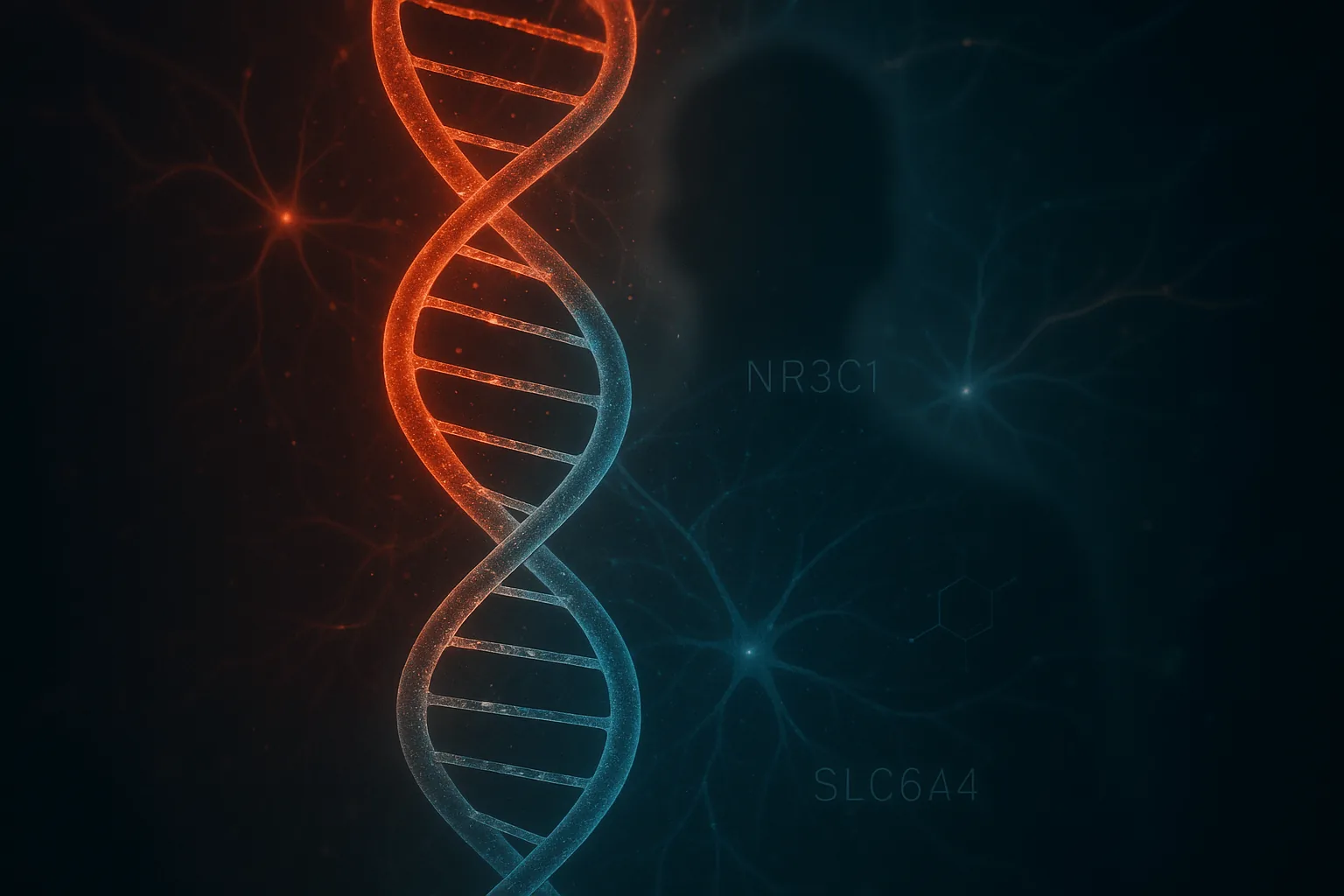
When people say trauma affects our genetics, it tends to stay abstract — a phrase that lands with weight but seemingly has no clear explanation. Epigenetics makes it concrete: real switches in the body, flipped by real experience.

I chose these three genes deliberately. Together they regulate stress, mood, and reward — the systems that determine how safe the world feels, how stable we feel inside it, and how motivated or depleted we feel trying to move through it.

When early adversity recalibrates these systems, the baseline shifts. Stress runs louder. Mood sits lower. Natural reward feels muted — like the volume on ordinary life has been quietly turned down. Nothing is "broken," but the nervous system is primed — often without any conscious awareness — to seek relief.

Predisposition is not destiny — but it does change the starting conditions. And starting conditions matter.

The trap can be set by both nature and nurture long before a substance ever enters the picture. And when one finally does — something that powerfully quiets stress, lifts mood, or floods reward pathways that have been running on empty — it doesn't just feel good. It feels like a correction. Like finally breathing normally after years of not quite getting enough air.

These three examples show what it actually means when we say trauma alters biology. Not metaphor. Measurable shifts in how the brain and body regulate stress, mood, and motivation — the three systems sitting at the center of both trauma and addiction.

NR3C1
The Cortisol "Off-Switch"

System: Stress Regulation (HPA Axis)

What it does: Builds glucocorticoid receptors — the system responsible for telling your body, "You're safe now. Stand down."

When altered by stress: Methylation can reduce receptor availability, weakening that shutdown signal. The result isn’t just “stress” — it’s a system that struggles to turn off. Hypervigilance becomes baseline. The body stays braced. Anxiety shows up without a clear reason, because the system never got the message that the danger passed.

Healing direction: Repeated, real experiences of safety — not just insight — help rebuild this signal over time. This is where trauma-focused therapy and consistent environments matter: they don’t just change how you think, they retrain when your body is allowed to relax.

SLC6A4
The Serotonin Recycler

System: Mood Regulation

What it does: Regulates the serotonin transporter — controlling how long serotonin stays active in the space between brain cells.

When altered by stress: Epigenetic shifts can disrupt that balance. Serotonin doesn’t land or linger the way it should, and mood becomes less stable as a result. This can show up as low baseline mood, increased sensitivity to stress, or emotional reactions that feel stronger than the situation calls for — not because you’re overreacting, but because the system is under-supported.

Healing direction: Stability matters here more than intensity. Consistent routines, therapeutic support, and environments that feel predictable help restore rhythm to this system — not instantly, but gradually, as the brain relearns what “regulated” actually feels like.

DRD2
The Reward Sensitivity Regulator

System: Motivation & Reward

What it does: Builds dopamine D2 receptors — key components of the brain’s reward system and the circuitry that drives motivation, reinforcement, and meaning.

When altered by stress: Chronic adversity can blunt dopamine signaling and receptor sensitivity, flattening the reward system. Everyday life starts to feel dull, effortful, or pointless. When a substance floods that same system, the effect isn’t just pleasure — it can feel like relief, clarity, or finally “coming online.” That contrast is what makes the pull so powerful.

Healing direction: This system rebuilds slowly. Consistent engagement, physical movement, meaningful goals, and safe relationships help restore sensitivity over time — but this is measured in months and years, not quick fixes.

The Recover-You Critique

The Systemic Silence

We have known about the methylation of NR3C1 and the blunting of DRD2 receptors for decades. This is not "fringe" theory; it is foundational neurobiology.

Yet, most treatment models still walk you into a room and treat your hypervigilance as a lack of faith, your depletion as a lack of effort, and your cravings as a moral defect. They are asking you to change the "performance" of your life while completely ignoring the biological conductors — trauma and toxic stress — that are still standing at the podium, frantically waving the baton.

The logic is simple: If the system doesn't name the lever (epigenetics), it can't help you pull it. By keeping you in the dark about your own biology, the system ensures that when you struggle, you blame yourself instead of the calibration. Recover-You exists to turn the lights on.

// Testing, Measurement, and Misinterpretation

As the science of epigenetics has evolved, so has the attempt to measure it. One of the more significant developments came out of the Dunedin Study — researchers used decades of longitudinal health data to build something genuinely useful: a way to estimate not just how old a person is, but how fast their body is aging.

That work produced DunedinPACE (Pace of Aging) — a DNA methylation–based measure designed to quantify the rate at which multiple biological systems are changing in real time. Access is still limited — not part of standard medical care in Canada, typically available through private longevity clinics or third-party labs, and relatively expensive. Like much of this field, it's still evolving in how it should be interpreted. Which brings us to the part that matters most.

Recovery doesn't happen one variable at a time. The substance stops. Sleep stabilizes. Food improves. Therapy begins. Structure, connection, and environment shift together — all at once, all interacting. There is no clean way to isolate what caused what. The system is changing as a whole, and no test is going to disaggregate that for you.

What these markers can offer is something more modest — and more genuinely useful: a directional signal. Not proof that one specific intervention produced a specific outcome. Not a verdict on whether you're "fixed." A signal that the system is responding. That something, across the broader pattern of your life, is moving differently.

That matters — especially in recovery, where a person's self-assessment can lag behind real progress, get distorted by shame, or swing with mood. Biological markers, behavioural indicators, and external life measures can serve as useful supplementary evidence that change is occurring even when you can't feel it yet. They don't replace lived experience. They anchor it in something outside of moment-to-moment perception.

Used well, these tools offer something recovery rarely comes with: evidence that the needle is moving. Used poorly, they create false certainty — or reinforce the exact black-and-white thinking that recovery is trying to dismantle. The difference is in what you ask of them. Ask for a direction. Not a diagnosis.


BBC – How Life Experiences Shape Your Genes

Watch: BBC – How Life Experiences Shape Your Genes Watch on YouTube

This short BBC feature visualizes what the science on this page describes — how experiences, environment, and even healing can modify which genes are active or silent. It’s a clear, accessible look at epigenetic change in real time.

From Science to Story
The biology of change — in motion, not theory

Up to this point, you’ve read about the molecular “switches” that regulate how genes like NR3C1 and SLC6A4 respond to stress, nurture, and recovery. The BBC video beside this section translates that same concept visually — showing how signals from our daily lives instruct the body to activate or silence genes.

What makes this so powerful is that it bridges the gap between abstract science and lived experience. Whether those signals come from trauma, nutrition, or connection, each one shapes the symphony of gene expression happening beneath awareness — proof that biology is listening to experience every moment.

It’s also a reminder that healing isn’t only psychological. Every time you practice safety, compassion, or regulation, you are sending new biological instructions. Epigenetics makes visible what recovery feels like on the inside: a rewiring of the song itself.

“Our bodies have an incredible ability to adapt — to turn on or off parts of the genome according to our habits, our experiences, and the environments in which we live.” — BBC Epigenetics Feature

// Putting It All Together: Trauma, Addiction, and Recovery

Epigenetics helps explain what most people can feel but struggle to articulate — why history doesn't stay in the past, and why biology isn't just something you were handed at birth. It bridges the gap between what happened to you and what's happening inside you right now.

  • Predisposition vs. Destiny: You may carry certain genetic vulnerabilities — but genes rarely act alone. It's often the environment that pulls the trigger. The risk was loaded. The conditions fired it. Those are two very different things.
  • Transgenerational Impact: Trauma doesn't always stop with the person who experienced it. A parent's unresolved trauma can alter the epigenetic markings passed to their children — potentially pre-setting a stress response system that's already primed for threat before the child has encountered any. You can inherit the biological echo of something you never directly lived through. That's not an excuse. It's context — and it matters.
  • Hope in Recovery: This is not a story of permanent damage. Healing environments, consistent relationships, nutrition, movement, and trauma-focused therapy can send the nervous system new signals — signals it may, over time, begin to trust. Recovery is, on a molecular level, a sustained act of biological renovation. Slow. Nonlinear. And more possible than most people are ever told.
// The Positive Counterpoint
Flipping the Switches Back

The same pathways that allowed trauma to leave its mark can also be worked with — gradually, deliberately — for repair. Healing isn't about "trying to feel better." It's about sending consistent biological signals to your nervous system that say, over and over, until the body starts to believe it: the danger has passed. It's time to rebuild.

  • Trauma-focused therapies like EMDR, ART, and Somatic Experiencing don't just help you reframe what happened — they work at the level where fear and stress became physically embedded, helping to rewire circuits that have been running the same emergency protocol for years.
  • Consistent movement, restorative sleep, and nutrition aren't lifestyle suggestions. They are biological signals — instructions to the brain and body to repair, regulate, and gradually restore a baseline that chronic stress has been quietly dismantling.
  • Safe, consistent relationships that allow for co-regulation act as an external nervous system — teaching your body, through repeated experience, what safety actually feels like, until it can begin to hold that state on its own.
  • Mind-body practices — meditation, yoga, breathwork — work at the root of the stress response, gradually strengthening the systems that govern resilience and giving an overactivated nervous system permission to downregulate.

Your genes influence the starting conditions. Your daily choices influence what happens next. Healing isn't erasing the script trauma wrote — it's returning to the page, again and again, with new information about safety, capacity, and what's actually possible now. That work can always begin. It's rarely linear. And it's worth doing.

QUICK FAQ
Some epigenetic changes are highly stable — they bed in deep and persist. But many are dynamic, responsive, and capable of shifting with the right conditions. Think of it less like permanent marker and more like a whiteboard that someone wrote on in a hurry during a very bad year. The marks are real. They're not necessarily forever.
Commercial tests exist, but the science is still developing and they're not yet reliable enough to drive personal clinical decisions. The more useful truth is this: the most powerful levers for change don't require a test to access. Lifestyle, environment, relationships, and healing work are available right now — and the evidence behind them is considerably stronger than anything a consumer kit can currently offer.
No. And the science actually argues the opposite. Epigenetics is the study of how we adapt — which means it's also the study of how adaptation can continue to happen. What you do matters. What you choose consistently, over time, matters most. It gives a biological foundation to something recovery has always known: that change from the inside out is not just possible — it's what the system was built for.
// Final Word

Epigenetics reframes the story — not from brokenness to perfection, but from misalignment to adaptation. It doesn't promise you'll get back exactly what was taken. It offers something more honest than that: evidence that the same system shaped by pain can be reshaped by healing. Slowly. With effort. Over time.

Your DNA is the sheet music. But you are the conductor — and conductors interpret, adjust, and find new ways to play what's in front of them. The song may have started in chaos. That doesn't mean it has to stay there. With new rhythms, new refrains, and enough repetition, the performance can change in ways that matter.

Not just for you. For whoever comes after you.
That part isn't metaphor. It's molecular.

Where to Next?

Follow the next step in order, or branch out into related topics.

Sources + Further Reading
  1. Meaney, M. J., & Szyf, M. (2005). Environmental programming of stress responses through DNA methylation: life at the interface between a dynamic environment and a fixed genome. Dialogues in Clinical Neuroscience, 7(2), 103–123. Groundbreaking McGill University research showing that maternal care in rodents causes epigenetic changes — specifically methylation of the glucocorticoid receptor gene NR3C1 — that alter stress reactivity across the lifespan and can be passed to offspring. Established the biological mechanism for intergenerational transmission of stress vulnerability. View on PMC
  2. Weaver, I. C. G., et al. (2004). Epigenetic programming by maternal behavior. Nature Neuroscience, 7(8), 847–854. Demonstrates how maternal care in rats directly influences NR3C1 methylation patterns, altering offspring stress regulation in ways that persist into adulthood — a cornerstone study in trauma-epigenetic science showing how relationship quality leaves a measurable molecular signature. View on PubMed
  3. Tyrka, A. R., et al. (2012). Childhood adversity and epigenetic modulation of the leukocyte glucocorticoid receptor: preliminary findings in healthy adults. PLoS ONE, 7(1), e30148. Human study examining DNA methylation in adults with childhood abuse or neglect histories. Found significant hypermethylation of the NR3C1 (glucocorticoid receptor) gene compared to controls — establishing that early adversity programs long-term HPA axis sensitivity at the epigenetic level in humans, not only in animal models. View on PubMed
  4. Kang, H. J., Kim, J. M., et al. (2013). Association of SLC6A4 methylation with early adversity, characteristics and outcomes in depression. Progress in Neuro-Psychopharmacology & Biological Psychiatry, 44, 23–28. Human study linking early adversity with methylation of the SLC6A4 serotonin transporter gene — connecting disrupted serotonin regulation directly to trauma history and establishing a molecular basis for the depression vulnerability described on this page. View on PubMed
  5. Yehuda, R., et al. (2016). Holocaust exposure induced intergenerational effects on FKBP5 methylation. Biological Psychiatry, 80(5), 372–380. Also: Perroud, N., et al. (2014). Response to psychotherapy in borderline personality disorder and methylation status of the BDNF gene. Translational Psychiatry, 4(1), e423. Yehuda et al. demonstrated that Holocaust survivors and their children showed altered FKBP5 methylation — evidence of intergenerational epigenetic transmission. Perroud et al. found that psychotherapy produced measurable changes in BDNF gene methylation correlated with symptom improvement — providing direct evidence that epigenetic modifications are not fixed destiny and can respond to healing interventions. View Yehuda et al. on PubMed  ·  View Perroud et al. on PubMed
  6. Bale, T. L. (2015). Epigenetic and transgenerational reprogramming of brain development. Nature Reviews Neuroscience, 16(6), 332–344. Review of how parental stress and environmental exposures shape offspring neurodevelopment via epigenetic signaling — providing the mechanistic framework for understanding how a parent's unresolved trauma can pre-set a child's stress response before the child has encountered adversity directly. View on PubMed
  7. Berens, A. E., Jensen, S. K. G., & Nelson, C. A. (2017). Biological embedding of childhood adversity: from physiological mechanisms to clinical implications. BMC Medicine, 15(1), 135. Comprehensive review summarizing how adversity alters neuroendocrine, immune, and epigenetic pathways across development — and what those changes mean for clinical care, reinforcing why a biologically informed approach to recovery is not optional but necessary. View Article
  8. Romens, S. E., et al. (2015). Associations between early life stress and gene methylation in children. Child Development, 86(1), 303–309. Human data directly linking childhood adversity with methylation of stress-response genes in children — reinforcing that epigenetic programming by early experience is not a theoretical concept but a measurable biological reality occurring in real time during development. View on PubMed
  9. Szyf, M. (2011). DNA methylation, the early-life social environment and behavioural disorders. Journal of Neurodevelopmental Disorders, 3, 238–249. Foundational theoretical paper connecting social experience to lifelong biological adaptation through methylation — arguing that the social environment is not merely psychological but operates as a direct regulator of gene expression in ways that drive neurodevelopmental and behavioral outcomes. View on PubMed
  10. BBC. (2019). How life experiences shape your genes. Animated explainer illustrating how habits, environment, and experience influence gene expression and health outcomes — a clear, accessible visualization of the molecular science described on this page. Watch on YouTube

These sources provide the empirical foundation for this page's content — spanning molecular studies on NR3C1 and SLC6A4, intergenerational inheritance research, and the emerging evidence that recovery and safety can reverse stress-related epigenetic changes. Together, they highlight how trauma, addiction, and healing all leave measurable biological traces — and how those traces can be rewritten.

Feeling overwhelmed by what you’ve read? Support is here • Call 988 Anywhere in Canada 24/7 Suicide Crisis Line • In Alberta call 211 (community & mental health referrals) • Distress Line 780-482-HELP • 911 in emergencies